“We balance probabilities and choose the most likely. It is the scientific use of the imagination.”
Sherlock Holmes, from “The Hound of the Baskervilles”, by Sir Arthur Conan Doyle, 1901
Fantastically, this study doesn’t even include all the data which I have previously collected on decreasing homicides.
The next thing I’ll do is integrate that data into this new set.
Given more time, there’s a lot of data analysis left to do, and more images to add, however I’m pretty pleased with it just as it stands.
I believe that I have proved that the health of the ether is inexorably improving, and that moral and mental health vary directly with the health of the ether.
Decreasing Homicides - Proving Moral and Mental Health Vary With the Health of the Ether
By Jeff Miller, January 20, 2026
The following chart is from “Long Term Trends in Violent Crime”, by Manuel Eisner, published by the University of Chicago in 2003.
It depicts homicide rates in England, the Netherlands/Belgium, Scandinavia, Germany/Switzerland, and Italy from 13th Century to the 20th Century.

(Homicide rates in England, the Netherlands/Belgium, Scandinavia, Germany/Switzerland, and Italy from 13th Century to the 20th Century)
From 1200 to 2019, the homicide rate in Germany decreased by an annual average of .1%.
From 1200 to 2019, the homicide rate in Germany decreased by 97.97%, or by an almost infinite amount, from 37 per 100,000, the greatest in history, to .75 per 100,000, the fewest in history.
In his study “Long Term Trends in Violent Crime”, by Manuel Eisner, published by the University of Chicago in 2003, Manuel omitted the percentage decrease, said “interpersonal violence decreased remarkably in Europe between the mid-sixteenth and the early twentieth centuries”, and offered so suggestion as to what might have caused it.
Those are all examples of the propaganda technique known as “stonewalling”.
Michael is desperate to keep you from recognizing that the health of the ether is inexorably improving, and moral and mental health vary directly with the health of the ether.
Here’s a picture of Manuel Eisner, against a Satanic-green Kabbalist “Tree of Life” background, where he has his arms crossed in a purportedly-secret Masonic “gesture of recognition”.

(The University of Chicago’s Manuel Eisner)
Now here are a couple of 19th Century depictions of a Freemason using the same purportedly-secret crossed-arms “gesture of recognition” that the University of Chicago’s Manuel Eisner is in the photo immediately above.

(19th Century depictions of a Freemason using the purportedly-secret crossed-arms “gesture of recognition”.)
I have included Manuel Eisner’s picture so that you could get a better idea of what a generational Satanist Freemason of marginal influence looks like.
They are all related to one another through the maternal bloodline. Generational Satanists comprise between twenty and thirty percent of the populace, and are hiding in plain sight in every city, town and village on Earth. It’s how the few have controlled the many all the way back to Babylon, and before.
But they say that the hardest part of solving a problem is recognizing that you have one.
Don Croft used to say “Parasites fear exposure above all else”.
How long do you think that these people have left in power, now?
Please consider doing what you can to help speed the transition.
From 1200 to 2018, the homicide rate in Germany decreased by an annual average of .1%.
From 1200 to 2018, the homicide rate in Germany decreased by 97.4%, or by an almost infinite amount, from 37 per 100,000, the greatest in history, to .95 per 100,000.
From 1200 to 1932, homicides in Germany decreased continuously. Then, from 1925 to 1932, they increased suddenly and exponentially, only to decrease again from 1932 to increase suddenly and exponentially once again from 1974 to a modern-era high point in 1994.
From 1200 to 1500, the homicide rate in Germany and Switzerland decreased by an annual average of .2%.
From 1200 to 1500, the homicide rate in England decreased by 69.5%, or by more than two thirds, from an all-time high 23 per 100,000 to 7 per 100,000, the fewest in history.
From 1200 to 1400, the homicide rate decreased in England, Germany/Switzerland, and Belgium/the Netherlands.
From 1200 to 1400, the homicide rate in Belgium and the Netherlands decreased by an annual average of .02%.
From 1200 to 1400, the homicide rate in Belgium and the Netherlands decreased by 4.3%, from 47 per 100,000 to 45 per 100,000.
From 1200 to 1400, the homicide rate in Italy increased by 30.3%, or by almost one third, from 56 per 100,000 to 73 per 100,000.
Why did the homicide rate decrease in Belgium/the Netherlands and Germany/Switzerland from 1200 to 1400, but increase exponentially in Italy during the same time period?
Because from 1200 to 1300, Italy was rife with Warfare, while Belgium/the Netherlands and Germany/Switzerland were at peace.
From 1200 to 1400, the homicide rate in Germany and Switzerland decreased by an annual average of .3%.
From 1200 to 1400, the homicide rate in Germany and Switzerland decreased by 56.7%, or by more than half, from 37 per 100,000 the greatest in history, to 16 per 100,000, the fewest in history.
From 1200 to 1399, the homicide rate in England was 23 per 100,000, the greatest in history.
From 1200 to 1399, the homicide rate in Germany and Switzerland was 37 per 100,000, the greatest in history.
From 1200 to 1399, the homicide rate in Belgium and the Netherlands was 47 per 100,000, the greatest in history.
From 1200 to 1399, the homicide rate in Belgium and the Netherlands of 47 per 100,000 was 27% greater, or one third greater than the homicide rate of 37 per 100,000 in Germany and Switzerland.
Why?
Because of the Death energy generated by the Hundred Years’ War, which began in 1337, and involved Belgium, while Germany and Switzerland were at peace.
From 1200 to 1300, Italy was rife with Warfare, while Belgium/the Netherlands and Germany/Switzerland were at peace.
From 1300 to 1400, Northern Italy was divided into warring city-states, the most powerful being Milan, Florence, Pisa, Siena, Genoa, Ferrara, Mantua, Verona and Venice. High Medieval Northern Italy was further divided by the long-running battle for supremacy between the Papacy and the Holy Roman Empire. Warfare between the states was common, and invasion from outside Italy was confined to intermittent sorties of Holy Roman Emperors.
Flanders, Belgium remained a French tributary until the start of the Hundred Years’ War in 1337.
In 1337, the Hundred Years’ War began, involving Belgium.
From 1400 to 1650, the homicide rate in Germany and Switzerland decreased by 31.3%, or by almost one third, from 16 per 100,000, the fewest in history, to 11 per 100,000, the fewest in history.
From 1400 to 1600, the homicide rate in Scandinavia decreased by an annual average of .2%.
From 1400 to 1600, the homicide rate in Scandinavia decreased by 47.8%, or by almost half, from 46 per 100,000 to 24 per 100,000.
From 1400 to 1500, the homicide rate decreased in England, Germany/Switzerland, Belgium/the Netherlands, and Scandinavia.
From 1400 to 1500, the homicide rate in Germany and Switzerland decreased by an annual average of .31%.
From 1400 to 1500, the homicide rate in Italy decreased by an annual average of .36%.
From 1400 to 1500, the homicide rate in Belgium and the Netherlands decreased by an annual average of .44%.
From 1400 to 1500, the homicide rate in Scandinavia decreased by an annual average of .5%.
From 1400 to 1500, the homicide rate in Germany and Switzerland decreased by 31.3%, from 16 per 100,000, the fewest in history, to 11 per 100,000, the fewest in history.
From 1400 to 1500, the homicide rate in Italy decreased by 36%, or by more than one third, from an all-time high of 73 per 100,000 to an all-time low 47 per 100,000.
From 1400 to 1500, the homicide rate in Belgium and the Netherlands decreased by 44.4%, or by almost half, from 45 per 100,000, the fewest in history, to 25 per 100,000, the fewest in history.
From 1400 to 1500, the homicide rate in Scandinavia decreased by 54.3%, or by more than half, from 46 per 100,000 to 21 per 100,000, the fewest in history.
From 1400 to 1500, the homicide rate in Germany/Switzerland, Belgium/the Netherlands, Italy and Scandinavia decreased by an average of %.
From 1400 to 1500, the .44% average annual decrease in the homicide rate in Belgium and the Netherlands was 2,100% greater, or more than twenty times greater than its .02% average annual decrease from 1200 to 1400.
Given that moral and mental health vary directly with the health of the ether, then here we see the steady, exponential improvement in the health of the ether over hundreds of years, marching toward the end of the Mayan “long count” in 2012.
From 1400 to 1500, .31% average annual decrease in the homicide rate in Germany and Switzerland was 3.3% greater than its .3% average annual decrease from 1200 to 1400.
(check the two statistics above)
From 1400 to 1499, the homicide rate in Germany and Switzerland was 16 per 100,000, the fewest in history.
From 1400 to 1499, the homicide rate in Belgium and the Netherlands was 45 per 100,000.
“We reached Jargeau and began business at once. Joan sent forward a heavy force which hurled itself against the outworks in handsome style, and gained a footing and fought hard to keep it; but it presently began to fall back before a sortie from the city. Seeing this, Joan raised her battle-cry and led a new assault herself under a furious artillery fire. The Paladin was struck down at her side wounded, but she snatched her standard from his failing hand and plunged on through the ruck of flying missiles, cheering her men with encouraging cries; and then for a good time one had turmoil, and clash of steel, and collision and confusion of struggling multitudes, and the hoarse bellowing of the guns; and then the hiding of it all under a rolling firmament of smoke - a firmament through which veiled vacancies appeared for a moment now and then, giving fitful dim glimpses of the wild tragedy enacting beyond; and always at these times one caught sight of that slight figure in white mail which was the center and soul of our hope and trust, and whenever we saw that, with its back to us and its face to the fight, we knew that all was well. At last a great shout went up - a joyous roar of shoutings, in fact - and that was sign sufficient that the farbourgs were ours.”
From “Personal Recollections of Joan of Arc”, by Mark Twain, 1896, depicting a battle in France in 1429
From 1500 to 1650, the homicide rate in Scandinavia decreased by an annual average of .3%.
From 1500 to 1650, the .3% average annual decrease in the homicide rate in Scandinavia was 40% less, or almost half again less than its .5% average annual decrease from 1400 to 1500.
While homicides decreased from 1400 to 1650 thanks to the inexorable underlying improvement in the health of the ether on the way to the end of the Mayan “long count” in 2012, the rate of that decrease was slowing, going forward in time, blunted by?
(research wars in Scandinavia from 1500 to 1650).
From 1400 to 1500, the homicide rate in Scandinavia decreased by an annual average of .5%.
In 1494, France invaded Italy, wreaking widespread devastation on Northern Italy and ending the independence of many of the city-states.
From 1500 to 1650, the homicide rate in Scandinavia decreased by 42.8%, or by almost half, from 21 per 100,000, the fewest in history, to 12 per 100,000, the fewest in history.
From 1500 to 1600, the homicide rate in Italy decreased by an annual average of .32%
From 1500 to 1600, the homicide rate in Italy decreased by 31.9%, or by almost one third, from 47 per 100,000, the fewest in history, to 32 per 100,000, the fewest in history.
From 1500 to 1599, the homicide rate in England was 7 per 100,000, the fewest in history.
From 1500 to 1599 the homicide rate in Germany and Switzerland was 11 per 100,000, the fewest in history.
From 1500 to 1600, the homicide rate in Scandinavia increased by 14.3%, from 21 per 100,000, the fewest in history, to 24 per 100,000.
Why did the homicide rate in Scandinavia increase significantly from 1500 to 1600, for the first time in history, while it decreased by an even wider margin in Italy during the same time period?
That’s because Italy was at peace from 1559 onward, while, from 1563 to 1570, the Northern Seven Years’ War was the last serious attempt by a Danish King to re-create the Kalmar Union by force. The war ended with a minor Danish victory but not the total defeat of the Swedes.
In 1559, with the Peace of Cateau-Cambrésis, France renounced its claims in Italy, while the south of Italy remained under Spanish rule.
From 1563 to 1570, the Northern Seven Years’ War was the last serious attempt by a Danish King to re-create the Kalmar Union by force. The war ended with a minor Danish victory but not the total defeat of the Swedes.
From 1500 to 1600, the homicide rate in Belgium and the Netherlands decreased by an annual average of .76%.
From 1500 to 1600, the 76% decrease in the homicide rate in Belgium and the Netherlands was 71.1% greater, or almost three fourths greater than its 44.4% decrease from 1400 to 1500.
Given that moral and mental health vary directly with the health of the ether, then here we see the steady, exponential improvement in the health of the ether over hundreds of years, marching toward the end of the Mayan “long count” in 2012.
From 1500 to 1600 the homicide rate in Belgium and the Netherlands decreased by 76%, or by basically three fourths, from 25 per 100,000, the fewest in history, to 6 per 100,000, the fewest in history.
From 1500 to 1599, the homicide rate in Belgium and the Netherlands was 25 per 100,000, the fewest in history.
From 1563 to 1570, the Northern Seven Years’ War was the last serious attempt by a Danish King to re-create the Kalmar Union by force. The war ended with a minor Danish victory but not the total defeat of the Swedes.
From 1600 to 1700, the homicide rate in Belgium and the Netherlands increased by an annual average of .2%.
From 1600 to 1700, the homicide rate in Italy decreased by an annual average of .63%.
From 1600 to 1700, the homicide rate in Belgium and the Netherlands increased by 16.6%, from 6 per 100,000, the fewest in history, to 7 per 100,000.
From 1600 to 1700, the homicide rate in Italy decreased by 62.5%, or by almost two thirds, from 32 per 100,000, the fewest in history, to 12 per 100,000, the fewest in history.
From 1600 to 1700, the .63% average annual decrease in the homicide rate in Italy was 96.8% greater, or basically two times greater than its .32% average annual decrease from 1500 to 1600.
Given that moral and mental health vary directly with the health of the ether, then here we see the health of the ether in Italy increased exponentially from 1600 to 1700.
(explore)
From 1600 to 1700, the .2% average annual increase in the homicide rate in Belgium and the Netherlands was 126.3% less than its .76% average annual increase from 1500 to 1600.
After increasing exponentially all the way from 1200 to 1600, the homicide rate in Belgium and the Netherlands suddenly increased exponentially from 1600 to 1700, thanks to the Death energy generated when the Spanish besieged Ostend, Belgium, producing more than 100,000 casualties from 1601 to 1604, followed by the Death energy generated by the Thirty Years’ War from 1618 to 1648.
From 1600 to 1650, the homicide rate in Belgium and the Netherland was 6 per 100,000, the fewest in history.
From 1600 to 1650, the homicide rate in England decreased by an annual average of .7%.
From 1600 to 1650, the homicide rate in England decreased by 33.3%, or by one third, from 6 per 100,000, the fewest in history, to 4 per 100,000, the fewest in history.
From 1600 to 1649, the homicide rate in England was 6 per 100,000, the fewest in history.
From 1600 to 1649, the homicide rate in Germany and Switzerland was 11 per 100,000, the fewest in history.
In 1601, the Spanish besieged Ostend, Belgium, producing more than 100,000 casualties before Ostend finally fell in 1604.
From 1618 to 1648, the Thirty Years’ War was a conflict fought in the Central European territory of the Holy Roman Empire but also involving most of the major continental powers.
From 1650 to 1700, the homicide rate in Belgium and the Netherlands decreased by an annual average of .04%.
From 1650 to 1700, the homicide rate in England decreased by an annual average of 1%.
From 1650 to 1700, the homicide rate in Germany and Switzerland decreased by an annual average of 1.5%.
From 1650 to 1700, the homicide rate in Scandinavia decreased by an annual average of 1.5%.
From 1650 to 1670, the respective 1%, 1.5% and 1.5% average annual decreases in the homicide rate in Scandinavia, England, Germany/Switzerland and Scandinavia were statistically very similar.
From 1650 to 1670, the respective 1.5% average annual decreases in the homicide rate in Germany/Switzerland and Scandinavia were identical.
Homicides are decreasing at very similar rates regardless of culture or geography because the health of the ether is inexorably improving, and moral and mental health vary directly with the health of the ether.
From 1650 to 1700, after the end of the Thirty Years’ War in 1648, the homicide rate in Belgium and the Netherlands decreased by 22.2%, from 9 per 100,000 to 7 per 100,000.
From 1650 to 1700, the 1% average annual decrease in the homicide rate in England was 42.8% greater, or almost half again greater than its .7% average annual decrease from 1600 to 1650.
Given that moral and mental health vary directly with the health of the ether, then here we see the steady, exponential improvement in the health of the ether, marching toward the end of the Mayan “long count” in 2012.
The Hindu’s refer to it as the end of the “Kali Yuga”, or Age of Iron, to be followed by a new Golden Age.
From 1650 to 1700, the homicide rate in England decreased by 50%, from 4 per 100,000, the fewest in history, to 2 per 100,000, the fewest in history.
From 1650 to 1700, the 22.2% decrease in the homicide rate in Belgium and the Netherlands was 55.6% less, or half again less than the 50% decrease in the homicide rate in England. Why?
From 1650 to 1700, the 22.2% decrease in the homicide rate in Belgium and the Netherlands was 69.4% less, or more than two thirds half less than the 72.7% decrease in the homicide rate in Germany and Switzerland. Why?
(investigate war in England vs. Belgium and the Netherlands in the latter half of the 17th Century)
From 1650 to 1700, the homicide rate in Germany and Switzerland decreased by 72.7%, or by almost three fourths, from 11 per 100,000, the fewest in history, to 3 per 100,000, the fewest in history.
From 1650 to 1700, the homicide rate in Scandinavia decreased by 75%, or by three fourths, from 12 per 100,000, the fewest in history, to 3 per 100,000, the fewest in history.
From 1650 to 1700, the .04% average annual decrease in the homicide rate in Belgium and the Netherlands was 94.7% less than its .76% average annual decrease from 1500 to 1600.
After increasing exponentially all the way from 1200 to 1600, the homicide rate in Belgium and the Netherlands suddenly increased exponentially from 1650 to 1700, thanks to the Death energy generated by the War of Devolution (1667 to 1668), the Franco-Dutch War (1672 to 1678), the War of the Reunions (1683 to 1684), and the Nine Years’ War (1688 to 1697), all fought on Belgian soil.
From 1650 to 1700, the 1.5% average annual decrease in the homicide rate in Scandinavia was 200% greater, or three times greater than its .5% average annual decrease from 1400 to 1500.
Given that moral and mental health vary directly with the health of the ether, then here we see the steady, exponential improvement in the health of the ether over hundreds of years, marching toward the end of the Mayan “long count” in 2012.
From 1650 to 1700, the 1.5% average annual decrease in the homicide rate in Germany and Switzerland was 650% greater, or seven and a half times greater than its .2% average annual decrease from 1200 to 1500.
Given that moral and mental health vary directly with the health of the ether, then here we see the steady, exponential improvement in the health of the ether over hundreds of years, marching toward the end of the Mayan “long count” in 2012.
The Hindu’s refer to it as the end of the “Kali Yuga”, or Age of Iron, to be followed by a new Golden Age.
From 1650 to 1699, the homicide rate in Germany and Switzerland was 3 per 100,000, the fewest in history.
From 1650 to 1699, the homicide rate in England was 4 per 100,000, the fewest in history.
From 1667 to 1668, the War of Devolution was fought in Belgium.
From 1672 to 1678, the Franco-Dutch War was fought in Belgium.
From 1683 to 1684, the War of the Reunions was fought in Belgium.
From 1688 to 1697, the Nine Years’ War was fought in Belgium.
From 1700 to 1800, the homicide rate in England remained unchanged, at 2 per 100,000.
From 1700 to 1800, the homicide rate in Italy increased by an annual average of .5%.
From 1700 to 1800, the homicide rate in Germany and Switzerland decreased by an annual average of .6%.
Why did the homicide rate in Italy increase from 1700, but decrease in Germany and Switzerland during the same time period?
From 1700 to 1800, the .5% average annual increase in the homicide rate in Italy was 179.3% greater than its .63% average annual decrease from 1600 to 1700.
Given that moral and mental health vary directly with the health of the ether, what led to the sudden, hyper-exponential decrease in the health of the ether in Italy from 1700 to 1800?
I believe that it was due to the large injections of Death energy into the ether in Italy from the War of the Spanish Succession from 1701 to 1714, the War of the Quadruple Alliance from 1718 to 1720, and the Battle of Bitonto in 1738.
From 1701 to 1714, the War of the Spanish Succession in Italy was triggered by the death without issue of the last Habsburg king of Spain, Charles II, who fixed the Spanish inheritance on Philip, Duke of Anjou, the grandson of King Louis XIV of France.
From 1718 to 1720, Spain attempted to retake territories in Italy and to claim the French throne in the War of the Quadruple Alliance, but was again defeated.
In 1738, the Spaniards regained Naples and Sicily in Italy following the Battle of Bitonto.
From 1600 to 1700, the homicide rate in Italy decreased by an annual average of .63%.
From 1700 to 1800, the homicide rate in Italy increased by 50%, from 12 per 100,000 to 18 per 100,000.
From 1700 to 1800, the homicide rate in Germany and Switzerland decreased by 57.1%, or by more than half, from 7 per 100,000, the fewest in history, to 3 per 100,000, the fewest in history.
From 1700 to 1750, the homicide rate in Italy decreased by an annual average of .5%.
From 1700 to 1750, the homicide rate in Scandinavia decreased by an annual average of 1.5%.
From 1700 to 1750, the 1.5% average annual decrease in the homicide rate in Scandinavia was identical to its 1.5% average annual decrease from 1650 to 1700.
Since we know that the homicide rate in Scandinavia decreased exponentially from 1400 to 1600, this stasis from 1650 to 1750 indicates a decrease in health of the ether in Scandinavia from 1650 to 1750.
(investigate)
From 1700 to 1750, the homicide rate in Italy decreased by 25%, from 12 to 9 per 100,000, the fewest in history.
From 1700 to 1750, the homicide rate in Scandinavia decreased by 76.6%, or by more than two thirds, from 3 per 100,000, the fewest in history, to .7 per 100,000, the fewest in history.
From 1700 to 1749, the homicide rate in England was 2 per 100,000, the fewest in history.
From 1700 to 1749, the homicide rate in Germany and Switzerland was 7 per 100,000, the fewest in history.
From 1700 to 1721, the Great Northern War was fought between a coalition of Russia, Denmark-Norway and Saxony-Poland (from 1715 also Prussia and Hanover) on one side and Sweden on the other side.
From 1701 to 1714, the War of the Spanish Succession in Italy was triggered by the death without issue of the last Habsburg king of Spain, Charles II, who fixed the Spanish inheritance on Philip, Duke of Anjou, the grandson of King Louis XIV of France.
From 1718 to 1720, Spain attempted to retake territories in Italy and to claim the French throne in the War of the Quadruple Alliance, but was again defeated.
In 1738, the Spaniards regained Naples and Sicily in Italy following the Battle of Bitonto.
From 1740 to 1748, Germany’s King Frederick II (Frederick the Great) waged the War of the Austrian Succession.
From 1750 to 1900, the homicide rate in England decreased by an annual average of .1%.
From 1750 to 1900, the homicide rate in England decreased by 19.9%, or by basically one fifth, from 1 per 100,000, the fewest in history, to .8 per 100,000, the fewest in history.
From 1750 to 1800, the homicide rate in Belgium and the Netherlands decreased by an annual average of .5%.
From 1750 to 1800, the homicide rate in Scandinavia increased by an annual average of .9%.
From 1750 to 1800, the homicide rate in Italy increased by an annual average of 1%.
From 1750 to 1800, the homicide rate in Scandinavia increased by 42.8%, or by almost half, from an all-time low .7 per 100,000 to 1 per 100,000.
The homicide rate in Scandinavia decreased exponentially from 1400 to 1600, remained flat from 1650 to 1700, and, here, increased for the first time in history from 1750 to 1800.
I believe that it was because of the Death energy created by the Great Northern War from 1700 to 1721, fought between a coalition of Russia, Denmark-Norway and Saxony-Poland (from 1715 also Prussia and Hanover) on one side and Sweden on the other side.
From 1750 to 1800, after the dissipation of the Death energy generated by almost thirty years of war in Belgium from 1667 to 1697, the homicide rate in Belgium and the Netherlands decreased by 50%, or by half, from 4 per 100,000, the fewest in history, to 2 per 100,000, the fewest in history.
From 1750 to 1800, the homicide rate in Italy increased by 50%, from 9 per 100,000 to 18 per 100,000.
From 1750 to 1800, the .5% average annual increase in the homicide rate in Scandinavia was 133.3% greater than its 1.5% average annual decrease from 1700 to 1750.
What happened in Scandinavia from 1750 to 1800 that caused a sudden, hyper-exponential increase in the homicide rate, after it had decreased by more than two thirds from 1700 to 1750?
I believe that it was because of the Death energy created by the Great Northern War from 1700 to 1721, fought between a coalition of Russia, Denmark-Norway and Saxony-Poland (from 1715 also Prussia and Hanover) on one side and Sweden on the other side.
From 1750 to 1800, the 1% average annual increase in the homicide rate in Italy was 300% greater than its .5% average annual decrease from 1700 to 1750.
Given that moral and mental health vary directly with the health of the ether, what led to the sudden, hyper-exponential decrease in the health of the ether in Italy from 1750 to 1800?
I’m guessing that it’s because, from 1797 to 1799, Napoleon conquered most of Italy.
From 1750 to 1799, the homicide rate in England was 1 per 100,000, the fewest in history.
From 1750 to 1799, the homicide rate in Germany and Switzerland was 8 per 100,000.
From 1797 to 1799, Napoleon conquered most of Italy.
From 1800 to 1850, the homicide rate in Belgium and the Netherlands decreased by an annual average of .55%.
From 1800 to 1850, the homicide rate in Germany and Switzerland decreased by an annual average of .7%.
(statistically very similar, expand)
From 1800 to 1850, the .55% average annual decrease in the homicide rate in Belgium and the Netherlands was 10% greater than its .50% average annual decrease from 1750 to 1800.
Given that moral and mental health vary directly with the health of the ether, then here we see the steady, exponential improvement in the health of the ether over hundreds of years, marching toward the end of the Mayan “long count” in 2012.
From 1800 to 1850, after the dissipation of Death energy generated by the War of the Austrian Succession from 1740 to 1748, the .7% average annual decrease in the homicide rate in Germany and Switzerland was 16.6% greater than its .6% average annual decrease from 1700 to 1800.
From 1800 to 1850, the homicide rate in Belgium and the Netherlands decreased by 55%, or by more than half, from 2 per 100,000, the fewest in history, to .9 per 100,000, the fewest in history.
From 1800 to 1850, the 16.6% positive variance in the average annual decrease in the homicide rate in Germany and Switzerland vs. 1700 to 1800 was 97.4% less, or almost infinitely less than the 650% positive variance from 1650 to 1700 versus 1200 to 1500.
(investigate Germany and Switzerland history from 1700 to 1800).
From 1800 to 1850, the homicide rate in Germany and Switzerland decreased by 33.3%, or by one third, from 3 per 100,000, the fewest in history, to 2 per 100,000, the fewest in history.
From 1800 to 1825, the homicide rate in England decreased by an annual average of .6%.
From 1800 to 1825, the homicide rate in Italy decreased by an annual average of .7%.
From 1800 to 1825 the homicide rate in Italy decreased by an annual average of 3.3%.
From 1800 to 1825, the respective .6% and .7% average annual decreases in the homicide rate in England and Italy were statistically very similar.
No wars were being fought in the nations of England or Italy from 1800 to 1825.
Homicides are decreasing at very similar rates regardless of culture or geography because the health of the ether is inexorably improving, and moral and mental health vary directly with the health of the ether.
From 1800 to 1825, the homicide rate in Scandinavia increased by an annual average of 1.6%.
From 1800 to 1825, the homicide rate in England decreased by 15%, from 2 per 100,000 to 1.7 per 100,000.
From 1800 to 1825, the homicide rate in Italy decreased by 16.7%, from 18 per 100,000 to 15 per 100,000.
From 1800 to 1825, the homicide rate in Scandinavia increased by 40%, or by almost half, from 1 per 100,000 to 1.4 per 100,000.
From 1800 to 1825, the 1.6% average annual increase in the homicide rate in Scandinavia was 77.7% greater, or almost two thirds greater than its .9% average annual increase from 1750 to 1800.
Given that moral and mental health vary directly with the health of the ether, what could have introduced a large amount of Death energy into the environment in Scandinavia from 1800 to 1825?
From 1800 to 1825, the .7% average annual decrease in the homicide rate in Italy was 170% greater than its 1% average annual increase from 1750 to 1800.
Italy was at peace from 1800 to 1825, and the Death energy generated by Napoleon’s conquering of Italy from 1797 to 1799 had dissipated.
From 1800 to 1825, the 1.6% average annual increase in the homicide rate in Scandinavia was 366.6% greater, or more than four times greater than the .6% average annual decrease in the homicide rate in England.
Why?
Scandinavia fought in the Napoleonic Wars from 1800 to 1814, while no wars were fought on English soil during the same time period.
From 1800 to 1825 the 1.6 average annual decrease in the homicide rate in Scandinavia was less 420% greater than its .5% average annual increase from 1750 to 1800.
Given that moral and mental health vary directly with the health of the ether, there’s been a quantum change for the better in the health of the ether in Scandinavia from 1825 to 1850. What caused it?
There was no war in Scandinavia from 1825 to 1850, versus Scandinavia’s fighting in the Napoleonic Wars from 1800 to 1814.
Moral and mental health vary directly with the health of the ether.
From 1800 to 1824, the homicide rate in England was 2 per 100,000.
From 1800 to 1824, the homicide rate in Germany and Switzerland was 3 per 100,000, the fewest in history.
From 1800 to 1814, Scandinavia was fighting in the Napoleonic Wars.
From 1825 to 1850, the homicide rate in Scandinavia decreased by an annual average of .6%.
From 1825 to 1850, the homicide rate in Scandinavia decreased by 14.2%, from 1.4 per 100,000 to 1.2 per 100,000.
From 1825 to 1850, the .6% average annual decrease in the homicide rate in Scandinavia was 137.5% greater than its 1.6% average annual increase from 1800 to 1825.
From 1825 to 1849, the homicide rate in England was 1.7 per 100,000.
From 1825 to 1849 the homicide rate in Germany and Switzerland was 4 per 100,000.
From 1825 to 1849, the homicide rate in Germany and Switzerland of 4 per 100,000 was 135.3% greater, or more than two times greater than the homicide rate of 1.7 per 100,000 in England.
Why?
I believe that would be because of the Death energy generated by the French Revolutionary and Napoleonic Wars, versus England, where no wars were fought.
In 1815, continental Europe was in a state of overall turbulence and exhaustion, as a consequence of the French Revolutionary and Napoleonic Wars.
From the mid 1820’s to 1830, industrialization took place in Wallonia, Belgium. The availability of cheap coal was a main factor that attracted entrepreneurs. Coke blast furnaces as well as puddling and rolling mills were built in the coal mining areas around Liège and Charleroi. The leader was a transplanted Englishman, John Cockerill. His factories at Seraing integrated all stages of production, from engineering to the supply of raw materials, as early as 1825.
Industry spread through the Sillon industriel (“industrial district”), Haine, Sambre and Meuse valleys. By 1830 when iron became important the Belgian coal industry had been long-established, and used steam engines for pumping. Coal was sold to local mills and railways as well as to France and Prussia.
On April 1, 1845, the US Post Office Department inaugurated the first commercial telegraph service.
From 1850 to 1994, the homicide rate in Germany and Switzerland increased by an annual average of .1%.
From 1850 to 1994, the homicide rate in Germany and Switzerland increased by 20.5%, or by one fifth, from 2 per 100,00, the fewest in history, to 2.41 per 100,000, a level not seen since 1800 to 1824.
From 1850 to 1875, the homicide rate in Scandinavia decreased by an annual average of 1%.
From 1850 to 1875, the homicide rate in Scandinavia decreased by 25%, or by one fourth, from 1.2 per 100,000 to .9 per 100,000,
From 1850 to 1875, the 1% average annual decrease in the homicide rate in Scandinavia was 66.6% greater, or two thirds greater than its .6% average annual decrease from 1825 to 1850.
Here, from 1850 to 1875, Scandinavia is still at peace, and the underlying health of the ether continues to improve exponentially on the way up to and through the end of the Mayan “long count” in 2012.
From 1850 to 1874, the homicide rate in England was 1.6 per 100,000.
From 1850 to 1874 the homicide rate in Germany and Switzerland was 2 per 100,000, the fewest in history.
From 1850 to 1875, the homicide rate in England decreased by an annual average of .7%.
From 1850 to 1875, the homicide rate in Germany decreased by an annual average of 1.2%.
From 1850 to 1875, the homicide rate in Belgium and the Netherlands increased by an annual average of 2.7%.
From 1850 to 1875, the homicide rate in England decreased by 18.7%, from 1.6 per 100,000 to 1.3 per 100,000.
From 1850 to 1875, the homicide rate in Germany decreased by 30%, or by almost one third, from 2 per 100,000, the fewest in history, to 1.4 per 100,000, the fewest in history.
From 1850 to 1875, the homicide rate in Belgium and the Netherlands increased by 66.6%, or by two thirds, from .9 per 100,000 to 1.5 per 100,000.
From 1850 to 1875, the 2.7% average annual increase in the homicide rate in Belgium and the Netherlands was 590% greater, or almost seven times greater than its .55% average annual decrease from 1800 to 1850.
This negative change was driven in part by the nascent technologies of the telegraph and the telephone, along with industrialization in Wallonia, Belgium starting in the mid-1820s, and especially after 1830.
From 1860 to 1890, the rate of imprisonment in the United States increased by 116.6%, or by more than two times, from 607 per million to 1,315 per million.
Given that moral and mental health vary directly with the health of the ether, this sudden, exponential, historically-unprecedented increase in crime was driven by the poisoning of the ether by technologies that include electrical grids, the telegraph and the telephone, along with a steady increase in death energy in the environment provided by ever-expanding graveyards.
From 1860 to 1870, the rate of imprisonment in the United States increased by 40.5%, from 607 per million to 853 per million.
In 1860, per Charles A. Ellwood in the Journal of Criminal Law and Criminology in 1910, the rate of imprisonment in the United States was 607 per million.
From 1875 to 1900, the homicide rate in Scandinavia decreased by an annual average of .4%.
From 1875 to 1900, .4% average annual decrease in the homicide rate in Scandinavia was 60% less than its 1% average annual decrease from 1850 to 1875.
Given that moral and mental health vary directly with the health of the ether, what force or facility exponentially increased Death energy into the environment from 1875 to 1900.
Since Scandinavia was not involved in war from 1875 to 1900, the blame must be squarely laid on the new technologies which included the telegraph, the telephone, and electrical grids.
From 1875 to 1900, the homicide rate in Scandinavia decreased by 11.1%, from .9 per 100,000 to .8 per 100,000.
From 1870 to 1880, the rate of imprisonment in the United States increased by 37.0%, from 853 per million to 1,169 per million.
From 1870 to 1880, the 37% increase in the rate of imprisonment in the United States was 24.1% less, or almost one fourth less than its 40.5% increase from 1860 to 1870.
The rate of the increase in crime in the United States decreased by almost one fourth from 1870 to 1880, despite rapid increases in population.
Here we see that the exponential, technology-driven increase in crime in the United States from 1860 to 1890 takes place within the larger context of an environment whose health was improving inexorably up to and beyond the end of the Mayan “long count” in 2012.
From 1870 to 1871, the Franco Prussian War was fought in Germany, with 180,000 deaths.
In 1870, per Charles A. Ellwood in the Journal of Criminal Law and Criminology in 1910, the rate of imprisonment in the United States was 853 per million.
From 1875 to 1900, the homicide rate in Belgium and the Netherlands increased by an annual average of .13%.
From 1875 to 1900, the homicide rate in Germany and Switzerland decreased by an annual average of .4%.
From 1875 to 1900, the homicide rate in Scandinavia decreased by an annual average of .4%.
From 1875 to 1900, the respective .4% average annual decreases in Germany/Switzerland and Scandinavia were identical.
From 1875 to 1900, the homicide rate in Germany and Switzerland decreased by 9%, from 2.2 per 100,000 to 2.0 per 100,000.
From 1875 to 1900, the homicide rate in Scandinavia decreased by 11.1%, from .9 per 100,000 to .8 per 100,000.
From 1875 to 1900, the homicide rate in Belgium and the Netherlands increased by 13.3%, from 1.5 per 100,000 to 1.7 per 100,000.
Why did homicides increase in Belgium and the Netherlands, but decrease in Germany and Switzerland?
From 1875 to 1900, the homicide rate in Belgium and the Netherlands increased by an annual average of .13%.
From 1875 to 1900, the .13% average annual increase in the homicide rate in Belgium and the Netherlands was 95.1% less than its 2.7% average annual increase from 1850 to 1875.
From 1875 to 1900, the homicide rate in England decreased by an annual average of 20.6%.
From 1875 to 1900, the .4% average annual decrease in the homicide rate in Germany and Switzerland was 66.6% less, or two thirds less than its 1.2% average annual decrease from 1850 to 1875.
Why was the decrease in the homicide rate in Germany and Switzerland from 1875 to 1890 exponentially less than its decrease from 1850 to 1875?
Because of the Death energy generated by the implementation of the telegraph, the telephone and electrical grids, along with the death energy generated by the 180,000 deaths in the Franco Prussian War, which was fought in Germany.
From 1875 to 1900, the homicide rate in England decreased by 515.3%, or by more than six times, from 1.3 per 100,000 to .8 per 100,000.
From 1875 to 1900, the 9% increase in the homicide rate in Germany and Switzerland was 98.2% less, or almost infinitely less than the 515.3% decrease in the homicide rate in England.
Why was the decrease in the homicide rate in Germany from 1875 to 1900 exponentially less than the decrease in England during the same time period?
That would be because of the Death energy generated by the 180,000 deaths of the Franco Prussian War, from 19 July 1870 to 28 January 1871, versus England with no war during the same time period.
From 1875 to 1900, the 20.6% average annual decrease in the homicide rate in England was 2,842% greater, or almost thirty times greater than its .7% average annual decrease from 1850 to 1875.
In response to this sudden, hyper-exponential decrease in the homicide rate in England, the literally blood-drinking Illuminists whom Don Croft used to refer to as “the Powers That Were” decided that we needed a World War, and a whole bunch of new technologies.
From 1875 to 1899, the homicide rate in England was 1.3 per 100,000.
From 1875 to 1899, the homicide rate in Germany was 2.2 per 100,000.
In 1877, the first commercial telephone service began in the United States.
The 1880’s saw long-distance telephone service grow via metallic circuits.
From 1880 to 1890, 12.4% increase in the rate of imprisonment in the United States was 66.4% less, or two thirds less than its 37% increase from 1870 to 1880.
From 1880 to 1890 versus 1870 to 1880, the 66.4% negative variance in the increase in the rate of imprisonment in the United States was 175.5% greater, or almost four times greater than its 24.1% negative variance from 1870 to 1880 versus 1860 to 1870
Given that moral and mental health vary directly with the health of the ether, then here we see the health of the ether improving exponentially from 1860 to 1890.
Here we see that the exponential, technology-driven increase in crime in the United States from 1860 to 1890 takes place within the larger context of an environment whose health was improving inexorably up to and beyond the end of the Mayan “long count” in 2012.
Here, in response to this sudden, hyper-exponential decrease in the crime rate in the United States, the literally blood-drinking Illuminists whom Don Croft used to refer to as “the Powers That Were” decided that we needed a World War, and a whole bunch of new technologies.
1880 to 1890, the number of prisoners in state prisons and penitentiaries in the United States increased by an annual average of 4.75%.
From 1880 to 1890, per Charles A. Ellwood in the Journal of Criminal Law and Criminology in 1910, the population of the United States increased by 24%.
From 1880 to 1890, the number of prisoners in state prisons and penitentiaries in the United States increased by an annual average of 4.75%.
From 1880 to 1890, the number of prisoners in state prisons and penitentiaries in the United States increased by 47.5%, or by almost half, or by 14,574 prisoners, from 30,659 to 45,233.
From 1880 to 1890, the 47.5% increase in the number of prisoners in state prisons and penitentiaries in the United States was 97.9% greater, or basically two times greater than the 24% increase in the population of the United States during the same time period.
Crime of all types increased exponentially in the United States from 1880 to 1890 because of Death energy released into the ether by the telegraph, the telephone, and electrical grids.
In 1880, per Charles A. Ellwood in the Journal of Criminal Law and Criminology in 1910, “the census showed the number of prisoners in state prisons and penitentiaries to be 30,659”.
In 1880, per Charles A. Ellwood in the Journal of Criminal Law and Criminology in 1910, the rate of imprisonment in the United States was 1,169 per million.
In 1882 Thomas Edison constructed Pearl Street Station, the first purpose-built power station. Built in New York City, this station provided the first electric light to Wall Street financiers and the New York Times.
From 1890 to 1904, the number of prisoners in state prisons and penitentiaries in the United States increased by an annual average of 7%.
From 1890 to 1904, the 7% average annual increase in the number of prisoners in state prisons and penitentiaries in the United States was 47.4% greater, or almost half again greater than its 4.75% average annual increase from 1880 to 1890.
In his study in the Journal of Law and Criminology in 2010, author Charles A. Ellwood omitted this statistic.
That is an example of the propaganda technique known as “stonewalling”.
Mr. Ellwood is desperate to keep you from recognizing that crime in the United States increased exponentially from 1880 to 1904 because of the Death energy released into the ether by the telegraph, the telephone, and electrical grids.
From 1890 to 1904, the number of prisoners in state prisons and penitentiaries in the United States increased by 97.5%, or by basically two times, or by 29,894 prisoners, from 30,659 to 60,553.
Let that sink in for a moment. The prison population in the United States basically doubled in just fourteen years.
That sudden, hyper-exponential increase in crime in the United States was driven by the Death energy released into the ether by the telegraph, the telephone, and electrical grids.
From 1890 to 1895, the population of the United States increased by an annual average of 2%.
From 1890 to 1895, the number of prisoners in state prisons and penitentiaries in the United States increased by an annual average of 4%.
From 1890 to 1895, the 4% average annual increase in the number of prisoners in state prisons and penitentiaries in the United States was 100% greater, or two times greater than the 2% average annual increase in the population of the United States during the same time period.
Here, with the implementation of the first electrical grids just ten years earlier, we see clear evidence of the plague of technology-driven crime.
Moral and mental health vary directly with the health of the ether.
From 1890 to 1895, per Charles A. Ellwood in the Journal of Criminal Law and Criminology in 1910, “the population, we note, could not have increased much more than ten per cent”.
From 1890 to 1895, the number of prisoners in state prisons and penitentiaries in the United States increased by an annual average of 4%.
From 1890 to 1895, the 4% average annual increase in the number of prisoners in state prisons and penitentiaries in the United States was 15.8% less than its 4.75% average annual increase from 1880 to 1890.
Here, from 1890 to 1895, despite the plague of technology-driven crime, the health of the ether is still ultimately improving at a rate greater than the nascent technology of the day’s ability to degrade it.
From 1890 to 1895, the number of prisoners in state prisons and penitentiaries in the United States increased by 19.9%, or by basically one fifth, or by 9,011 prisoners, from 45,233 to 54,244.
In 1890, there was a system whereby news, music, live theatre, music hall, fiction readings, religious broadcasts, etc., were available in private homes [and other places] via the conventional telephone line, with subscribers being supplied with a number of special, personalised headsets.
In Britain this system was known as Electrophone; in Hungary, it was called Telefon Hírmondó; and in France, Théâtrophone.
In 1890, per Charles A. Ellwood in the Journal of Criminal Law and Criminology in 1910, the number of prisoners in state prisons and penitentiaries in the United States was 45,233.
In 1890, per Charles A. Ellwood in the Journal of Criminal Law and Criminology in 1910, the rate of imprisonment in the United States was 1,315 per million.
From 1895 to 1904, the number of prisoners in state prisons and penitentiaries in the United States increased by an annual average of 1.3%.
From 1895 to 1904, the number of prisoners in state prisons and penitentiaries in the United States increased by 11.6%, or by 6,309 prisoners, from 54,244 to 60,553.
From 1895 to 1904, the 1.3% average annual increase in the number of prisoners in state prisons and penitentiaries in the United States was 67.5% less, or more than two thirds less than its 4% average annual increase from 1890 to 1895.
From 1895 to 1904, the 67.5% negative variance in the increase in the number of prisoners in state prisons and penitentiaries in the United States versus 1890 to 1895 was 327.2% greater, or more than four times greater than its 15.8% negative variance from 1890 to 1895 versus 1880 to 1890.
Given that moral and mental health vary directly with the health of the ether, this statistic documents that, from 1880 to 1904, the underlying health of the ether was improving exponentially at a rate exponentially greater than the ability of the nascent technologies of the day to degrade it.
In 1895, Guglielmo Marconi made the first radio transmission from a temporary station set up on the Isle of Wight in England.
In 1895, per Charles A. Ellwood in the Journal of Criminal Law and Criminology in 1910, the number of prisoners in state prisons and penitentiaries in the United States was 54,244.
Here’s a chart of homicides in England and Wales from 1898 to 2024.
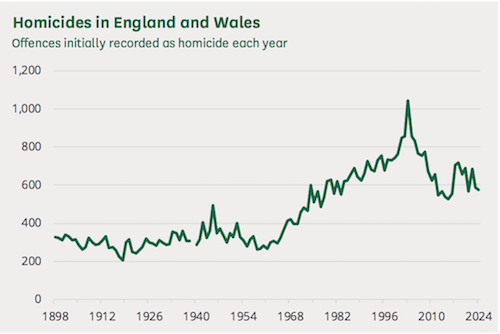
(A chart of homicides in England and Wales from 1898 to 2024)
From 1898 to 1916, homicides in England and Wales decreased by an annual average of 2.1%.
From 1898 to 1916, homicides in England and Wales decreased by 38.5%, or by more than one third, from 325 to 200.
In 1898, per the home office in the U.K., there were (approximately) 325 homicides in England and Wales.
From 1899 to 1924, the homicide rate in Germany decreased by an annual average of 1.5%.
From 1899 to 1924, the 1.5% average annual decrease in the homicide rate in Germany was 275% greater, or almost four times greater than its .4% average annual decrease from 1875 to 1900.
This is where the Powers That Be decided that one World War beat-down on Germany just wasn’t enough.
From 1899 to 1924, the homicide rate in Germany decreased by 36.3%, or by more than one third, from 2.2 per 100,000 to 1.4 per 100,000.
The image immediately below is a chart of homicide rates in the United States from 1900 to 1973.
It’s from a study entitled “Homicide Trends in the United States, 1900-1974”, written by A. Joan Klebba, M.A. in 1974.
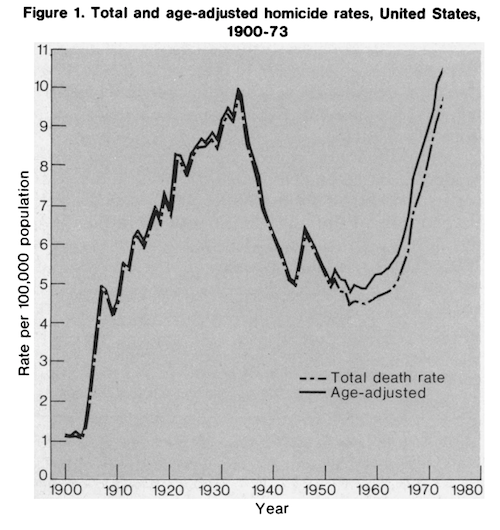
(The homicide rates in the United States from 1900 to 1973)
From 1900 to 1950, the homicide rate in England decreased by an annual average of .3%.
From 1900 to 1950, the homicide rate in England decreased by 12.5%, from .8 per 100,000 to .7 per 100,000.
From 1900 to 1950, the .3% average annual decrease in the homicide rate in England was 98.5% less, or almost infinitely less than its 20.6% average annual decrease from 1875 to 1900.
While the homicide rate in England decreased continuously from 1875 to 1950, the rate of that decrease has been hyper-exponentially slowed by the Death Energy from two World Wars, along with new technologies including radar, high tension power lines, and microwave television transmissions, to name only three of many.
From 1900 to 1924, the homicide rate in England was .8 per 100,000.
From 1900 to 1924, the homicide rate in Germany was 2.0 per 100,000, the fewest in history, tying the 2.0 per 100,000 rate from 1850 to 1874.
From 1900 to 1925, the homicide rate in Scandinavia decreased by an annual average of 1%.
From 1900 to 1925, the homicide rate in Germany decreased by an annual average of 1.2%.
From 1900 to 1925, the homicide rate in England and Wales decreased by 23.8%, from 1.05 per 100,000 to .8 per 100,000.
From 1900 to 1925, the homicide rate in Scandinavia decreased by 25%, from .8 per 100,000 to .6 per 100,000, the fewest in history.
From 1900 to 1925, the homicide rate in Germany decreased by 30%, from 2.0 per 100,000 to 1.4 per 100,000.
From 1900 to 1925, the respective 23.8% and 30% decreases in the homicide rate in England/Wales and Germany were statistically very similar.
Here, from 1900 to 1925, even factoring in the massive output of Death energy from World War I, homicides are decreasing exponentially at very similar rates regardless of culture or geography because the health of the ether is inexorably improving, and moral and mental health vary directly with the health of the ether.
From 1900 to 1925, the 1% average annual decrease in the homicide rate in Scandinavia was 150% greater, or two and a half times greater than its .4% average annual decrease from 1875 to 1900.
Here, from 1875 to 1925, in the absence of warfare, and mostly in the absence of technology, the homicide rate in Scandinavia is decreasing hyper-exponentially, thanks to the inexorable underlying improvement in the health of the ether on the way up to and through the end of the Mayan “long count” in 2012.
From 1900 to 1903, the the homicide rate in the United States remained unchanged, at 1.2 per 100,000, the lowest since record keeping began.
In 1900, the homicide rate in the United States was 1.2 per 100,000, the lowest since record keeping began.
From 1903 to 1933, the homicide rate in the United States increased by an annual average of 7%.
From 1903 to 1933, the homicide rate in the United States increased by 708.3%, or by more than eight times, from an all-time low 1.2 per 100,000 to an all-time high 9.7 per 100,000.
What could have caused this sudden, hyper-exponential increase in homicide?
It is certainly not a societal or cultural lever, such as “violence in the media”.
While there was an hyper-exponential increase in crime in the United States from 1860 to 1890, the lack of an increase in homicide from 1900 to 1903 shows that electrical grids, the telephone and the telegraph did not move the needle like the transmission of radio waves through the air, through the ether did going forward into the 20th Century.
From 1900 to 1932, the homicide rate in Germany decreased by an annual average of .2%.
From 1900 to 1932, the homicide rate in England and Wales decreased by 28.6%, from 1.05 per 100,000 to .75 per 100,000.
From 1900 to 1932, the homicide rate in Germany decreased by 5%, from 2.0 per 100,000 to 1.9 per 100,000.
From 1900 to 1932, the 5% decrease in the homicide rate in Germany was 82.5% less, or more than three fourths less than the 28.6% decrease in the homicide rate in England and Wales.
What’s the variable?
The Death energy from World War I, which was fought on German soil, that’s what.
In 1903, the homicide rate in the United States was 1.2 per 100,000, tied with 1900 as the lowest since record keeping began.
In 1904, per Charles A. Ellwood in the Journal of Criminal Law and Criminology in 1910, the number of prisoners in state prisons and penitentiaries was 60,553.
In 1904, German inventor Christian Hülsmeyer first used radio waves to build a simple ship detection device intended to help avoid collisions in fog.
In 1905-06, radio broadcasting of music and talk intended to reach a dispersed audience started experimentally.
In 1910, the Journal of Criminal Law and Criminology published a study by Charles A. Ellwood which questioned “Has Crime Increased in the United States Since 1880”.
When, in fact, from 1890 to 1904, the number of prisoners in state prisons and penitentiaries in the United States increased by 97.5%, or by basically two times, or by 29,894 prisoners, from 30,659 to 60,553, at a rate 100% greater, or two times greater than the 2% average annual increase in the population of the United States during the same time period.
I generated those percentage increases from Mr. Ellwood’s own study, while Mr. Ellwood took care to omit both of them.
As you can see, Charles A. Ellwood and the Journal of Criminal Law and Criminology are using an example of the propaganda technique known as “the Big Lie”.
I have exposed their duplicity by using what was known in the old days as “fact checking”.
Here’s a picture of Charles A. Ellwood.

(Charles A. Ellwood)
I have included his picture so that you could get a better idea of what a generational Satanist Freemason of marginal influence looks like.
They are all related to one another through the maternal bloodline.
Generational Satanists comprise between twenty and thirty percent of the populace, and are hiding in plain sight in every city, town and village on Earth.
It’s how the few have controlled the many all the way back to Babylon, and before.
But they say that the hardest part of solving a problem is recognizing that you have one.
Don Croft used to say “Parasites fear exposure above all else”.
How long do you think that these people have left in power, now?
Please consider doing what you can to help speed the transition.
From 1916 to 1946, homicides in England and Wales increased by 145%, or by almost one and a half times, from 200 to 490.
After decreasing by more than a third over the 18 years from 1898 to 1916, homicides in England have suddenly increased hyper-exponentially. What could possibly be the reason?
That would be the Death energy from two World Wars, coupled with the poisoning of the ether by the transmission of radio waves and radar through the air, through the ether.
In 1916, there were (approximately) 200 homicides in England and Wales.
From 1925 to 1950, the homicide rate in Scandinavia remained unchanged, at .6 per 100,000.
Since we know that the underlying health of the ether in Scandinavia has been improving exponentially all the way from 1400 to 1925, this statis shows us that something is negatively impacting the health of the ether from 1925 to 1950.
That would be the Death energy of World War II, along with the steady increase in Death energy injected into the ether by technologies that include electrical grids, radio, radar, television, and microwave communications.
From 1925 to 1949, the homicide rate in England was .8 per 100,000.
From 1925 to 1932, the homicide rate in Germany increased by an annual average of 5.1%.
From 1925 to 1932, the homicide rate in Germany increased by 35.7%, or by more than one third, from 1.4 per 100,000 to 1.9 per 100,000.
This after homicides in German decreased continuously all the way from 1200 to 1925.
From 1925 to 1932, the 35.7% increase in the homicide rate was 219% less, or more than three times less than its 30% decrease from 1900 to 1925.
From 1925 to 1932, the 5.1% average annual increase in the homidice rate in Germany was 2,650% greater, or more than twenty seven times greater than its .2% average annual decrease from 1900 to 1925.
This is hard, cold proof of the fact that Death energy in the environment drives homicides. That moral and mental health vary with that of the subject’s etheric environment.
From 1925 to 1949, the homicide rate in Germany was 1.4 per 100,000.
From 1932 to 2024, murders in Germany decreased by an annual average of .9%.
From 1932 to 2024, murders in Germany decreased by 82.2%, or by more than three fourths, from 1,249 to 222.
From 1932 to 2023, the homicide rate in Germany decreased by an annual average of .6%.
From 1932 to 2024, the homicide rate in Germany decreased by 52.6%, or by more than half, from 1.9 per 100,000 to .9 per 100,000.
From 1932 to 2024, the .6% average annual decrease in the homicide rate in Germany was 111.8% less, or over two times less than its 5.1% average annual increase from 1925 to 1932.
Here, at the broadest view, up to and through the end of the Mayan “long count” in 2012, homicides in Germany are decreasing again, at a rate greater than that of technology’s ability to increase them.
Now we will look at the time period from 1932 to 2023 in closer detail.
From 1932 to 2023, homicides in Germany decreased by 76%, or by more than three fourths, from 1,249 to 299.
From 1932 to 1950, the homicide rate in Germany decreased by an annual average of 2.9%.
From 1932 to 1950, the 2.9% average annual decrease in the homicide rate in Germany was 156.9% less, or more than two and a half times less than its 5.1% average annual increase from 1925 to 1932.
From 1932 to 1950, the 2.9% average annual decrease in the homicide rate in Germany was 1,350% greater, or more than fourteen times greater than its .2% average annual decrease from 1900 to 1932.
Here, after the only increase in homicide ever documented in Germany’s history, we see homicides decreasing exponentially once again. The inexorable improvement in the health of the ether continues at a rate greater than that of the Death energy from War or from the technology of the day’s ability to degrade it.
From 1932 to 1950, the homicide rate in Germany decreased by 52.6%, or by more than half, from 1.9 per 100,000 to .9 per 100,000.
In 1932, there were 1,249 murders in Germany.
In 1932, per murdermap.co.uk, the homicide rate in in England and Wales was .75 per 100,000.
In 1932, homicide rate in Germany was 1.9 per 100,000 people.
From 1933 to 1950, the homicide rate in the United States decreased by an annual average of 6.8%.
From 1933 to 1950, the 6.8% average annual decrease in the homicide rate in the United States was 134.5% greater, or more than two times greater than the 2.9% average annual decrease in the homicide rate in Germany.
While homicides are decreasing in both locations, thanks to the inexorable improvement in the health of the ether on the way to the end of the Mayan “long count” in 2012, the are doing so at an exponentially lower rate in Germany due to the Death energy remaining in the environment there from two World Wars.
From 1933 to 1950, the homicide rate in the United States decreased by 47.4%, or by almost half, from an all-time high 9.7 per 100,000 to 5.1 per 100,000, the latter being roughly the level at which it was in 1909.
What could have possibly caused this exponential decrease in homicide?
It was certainly not “improved family values”, nor “moral education via radio shows such as ‘Little Orphan Annie’.”
This statistic demonstrates that the health of the ether was improving inexorably up to and beyond the end of the Mayan “long count” in 2012, despite the best efforts of technology to stop or slow it.
In 1933, the homicide rate in the United States was an all-time high 9.7 per 100,000.
It had been driven to that peak by both the new technologies of radio and radar, and was also assisted by the Death energy from World War II.
From 1934 to 1939, the United Kingdom, Germany, the United States, the USSR, Japan, the Netherlands, France, Italy, Australia, Canada, New Zealand, and South Africa developed radar systems which produced short pulses of radio energy to locate a target relative to the antenna.
From 1946 to 1957, homicides in England and Wales decreased by an annual average of 4.6%.
From 1946 to 1957, homicides in England and Wales decreased by 51%, or by more than half, from 490 to 240.
What gives? After increasing by almost one and a half times from 1916 to 1946, homicides in England and Wales have now suddenly decreased again by half from 1946 to 1957.
Here, from 1946 to 1957, the Death energy from World War II has dissipated, while the underlying health of the ether continues to improve on the way toward the end of the Mayan “long count” in 2012, and for the moment that improvement is stronger than the technology of the day’s ability to slow or stop it.
From 1946 to 1950, the 6.8% average annual decrease in the homicide rate in the United States was 47.8% greater, or almost half again greater than the 4.6% average annual decrease in the homicide rate in England and Wales.
That’s because the level of the Death energy from World War II was exponentially greater in England than it was in the United States, the latter which was untouched by mass casualties.
In 1946, there were (approximately) 490 homicides in England and Wales.
The following FBI crime data explorer chart documents the murder rate in the United States from 1950 to 2024.
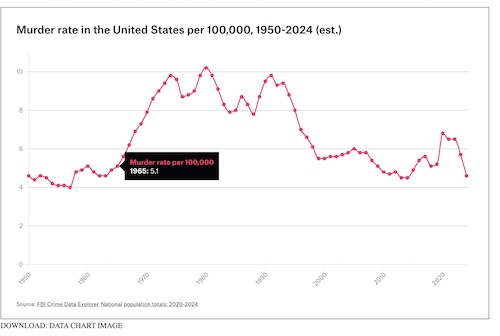
(FBI crime data explorer chart documenting the murder rate in the United States from 1950 to 2024)
From 1950 to 1999, the positive variance in the homicide rate in the United States versus Germany increased by an annual average of 1.6%.
From 1950 to 1975, the homicide rate in England and Wales increased by an annual average of 2.9%.
From 1950 to 1975, the homicide rate in Scandinavia increased by an annual average of 4%.
From 1950 to 1975, the homicide rate in England and Wales increased by 71.4%, or by almost three fourths, from .7 per 100,000 to 1.2 per 100,000.
Recapping: After decreasing by more than a third over the 18 years from 1898 to 1916, homicides in England increased by almost one and a half times from 1916 to 1946, thanks to new technologies which included radio and radar. Then, from 1946 to 1957, homicides in England and Wales decreased by more than half, as the rate of the improvement in the health of the ether pulled away beyond the ability of the technologies of the day to degrade them. Then, here from 1950 to 1975, the new technologies of high tension power transmission, television and microwave communications drove another exponential increase in homicide.
From 1950 to 1975, the homicide rate in Scandinavia increased by 100%, or by two times, from .6 per 100,000, the fewest in history, to 1.2 per 100,000.
Here, in the absence of any war in Scandinavia, the blame must be squarely laid on the ever-expanding plague of what we collectively refer to as “technology”.
In 1950, the homicide rate in the United States of 4.6 per 100,000 was 134.5% greater, or more than two times greater than the homicide rate in Germany of .9 per 100,000.
Here in 1950, what force, what influence is making citizens of the United States more than twice as murderous as the Germans?
For those who would hopefully suggest “handguns”, I would remind that the Germans make many of the world’s finest handguns, including Sigg Sauer, Walther, Heckler and Koch, and many others.
The variable in the homicide rate is the low-wavelength microwave radiation from what we collectively refer to as “technology”, which the United States created and adopted at a greater rate than any other nation on Earth.
From 1950 to 1973, the homicide rate in the United States increased by an annual average of 5.3%.
From 1950 to 1973, the 5.3% average annual increase in the homicide rate in the United States was 82.7% greater, or almost two times greater than the 2.9% average annual increase in the homicide rate in England and Wales.
This is particularly striking, given the fact that, from 1946 to 1950, the 6.8% average annual decrease in the homicide rate in the United States was 47.8% greater, or almost half again greater than the 4.6% average annual decrease in the homicide rate in England and Wales.
In the latter case, the level of the Death energy remaining from World War II was exponentially greater in England than it was in the United States, which, unlike England, was untouched by mass casualties.
Yet here from 1950 to 1973 the situation has been reversed, and homicides in the United States are increasing at a rate almost two times greater than they are in England and Wales.
This is easily attributable to the United States’ vigorous development and adoption of new technologies which included high tension power transmission, television and microwave at far more aggressive rate than did mostly-rural England and Wales.
From 1950 to 1973, the homicide rate in the United States increased by 121.7%, or by more than two times, from 4.6 per 100,000 to an all-time high 10.2 per 100,000.
Here, while purporting to be a scientist by trade, the University of Michigan’s A. Joan Klebba, MA omitted the percentage increase from her study, and explained that it was because of “increases in population between 1960 and 1972 for the age groups 15-19, 20-24, and 25-29.”
Where the general “increases in population” is an example of the propaganda technique known as “plausible deniability” or “the Big Lie”.
Joan is desperate to keep you from recognizing that moral and mental health vary directly with the health of the ether.
From 1950 to 1960, the homicide rate in the United States increased by an annual average of 1.0%.
From 1950 to 1960, the homicide rate in the United States increased by 10.8%, from 4.6 per 100,000 to 5.1 per 100,000.
From 1950 to 1974, the homicide rate in England was .7 per 100,000.
From 1950 to 1974, the homicide rate in Germany was .9 per 100,000.
In 1950, the homicide rate in the United States was 4.6 per 100,000.
Here, after peaking in 1933, the homicide rate in the United states has returned to roughly the level at which it was in 1907.
The health of the underlying environment is improving at a rate greater than technology’s ability to degrade it.
In 1950, the homicide rate in the United States of 4.6 per 100,000 was 134.5% greater, or more than two times greater than the homicide rate in Germany of .9 per 100,000.
Why are people in the United States acting twice as murderously as the people in Germany?
Because the United States is adopting and utilizing new technologies at an exponentially greater rate than Germany.
From 1957 to 2003, homicides in England and Wales increased by an annual average of 7.3%.
From 1957 to 2003, homicides in England and Wales increased by 337.5%, or by more than four times, from 240 to an all-time high 1,050.
From 1957 to 1972, homicides in England and Wales increased by an annual average of 10%.
To recap the history, homicides in England and Wales decreased by more than a third from 1898 to 1916, then suddenly increased by almost one and a half times from 1916 to 1946, only to decrease again by half from 1946 to 1957, and then, here, we see them suddenly increase again by more than four times from 1957 to 2003, to the highest level in history.
It’s kind of embarrassing when it’s spelled out directly like that, isn’t it?
What cultural, economic or sociological forces caused this hyper-exponential increase in homicides from 1957 to 2003? Most crucially, why were those forces not in play from 1946 to 1957?
The fact of the matter is that the homicide rate in England and Wales increased hyper-exponentially from 1957 to 2003, to the highest level in history, because the health of the ether was being degraded by the purportedly-harmless low-wavelength microwave radiation from high tension power lines, microwave television transmissions, and lastly, wireless cellular telephone technology.
In 1957, there were (approximately) 240 homicides in England and Wales.
From 1960 to 1973, the homicide rate in the United States increased by an annual average of 7%.
From 1960 to 1973, the 7% average annual increase in the homicide rate in the United States was 600% greater, or seven times greater than its 1% average annual increase from 1950 to 1960.
This hyper-exponential increase in the homicide rate from 1960 to 1973 is the result of the poisoning of the ether by the low-wavelength microwave radiation from what we collectively refer to as “technology”.
From 1960 to 1973, the 7% average annual increase in the homicide rate in the United States and its 7% average annual increase from 1903 to 1933 were identical.
From 1960 to 1973, the homicide rate in the United States increased by 92.2%, or almost two times, from 5.1 per 100,000 to an all-time high 9.8 per 100,00.
In 1960, the homicide rate in the United States was 5.1 per 100,000.
Here, in 1960, after peaking in 1933, the homicide rate in the United state has returned to roughly the level at which it was in 1910.
From 1960 to 1965, the homicide rate in England and Wales increased by 2.2%.
From 1960 to 1965, the homicide rate in England and Wales increased by 10.8%, from .61 per 100,000 to .68 per 100,000.
In 1960 the homicide rate in in England and Wales was .61 per 100,000.
From 1965 to 1975, the homicide rate in England and Wales increased by 55.3%, from .68 per 100,000 to 1.2 per 100,000.
From 1965 to 1975, the homicide rate in England and Wales increased by an annual average of 5.5%
From 1965 to 1975, the 5.5% average annual increase in the homicide rate in England and Wales was 85.7% greater, or almost two times greater than its 2.2% average annual increase from 1960 to 1965.
Homicides in England and Wales are increasing exponentially because the health of the ether was being degraded by the purportedly-harmless low-wavelength microwave radiation from what we collectively refer to as technology, including radio, radar, high tension power lines, microwave television transmissions, et al.
In 1965, the homicide rate in England and Wales was 0.68 per 100,000.
Here’s a chart showing the homicide rate in England and Wales from 1967 to 2024.
(Homicide rate in England and Wales from 1967 to 2024)
In 1971, the film “Dirty Harry” premiered in San Francisco, California.

(Clint Eastwood as “Dirty Harry”, 1971)
From 1972 to 2003, the 7.3% average annual increase in homicides in England and Wales was 27% less, or almost one third less than its 10% average annual increase from 1957 to 1972.
Here, from 1972 to 2003, homicides in England and Wales are still increasing, but the inexorable improvement in the health of the ether is slowing that increase.
In 1972, there were (approximately) 600 homicides in England and Wales.
From 1973 to 1980, the homicide rate in the United States increased by an annual average of .6%,
From 1973 to 1980, the homicide rate in the United States increased by 4%, from an all-time high 9.8 per 100,000 to an all-time high 10.2 per 100,000.
From 1973 to 1980, the .6% average annual increase in the homicide rate in the United States was 91.4% less, or seven times less than its 7% average annual increase from 1960 to 1973.
Here, from 1973 to 1980, homicides in the United States are still increasing, but the inexorable improvement in the health of the ether is slowing that increase.
In 1973, there were 20,465 homicides in the United States.
In 1973, the homicide rate in the United States was an all-time high 9.8 per 100,000.
From 1975 to 1994, the homicide rate in England was 1.2 per 100,000.
From 1975 to 1994, the homicide rate in Germany increased by an annual average of 5.3%.
From 1975 to 1994, the homicide rate in Germany increased by 100.8%, more more than two times, from 1.2 per 100,000 to 2.41 per 100,000, the latter a level not seen since 1800 to 1824.
Homicides in Germany are increasing exponentially because the health of the ether was being degraded by the purportedly-harmless low-wavelength microwave radiation from what we collectively refer to as technology, including radio, radar, high tension power lines, microwave television transmissions, et al.
From 1975 to 1993, the homicide rate in Germany and Switzerland was 1.2 per 100,000.
From 1975 to 1994, the homicide rate in Germany increased by an annual average of 5.3%.
From 1975 to 1990, the homicide rate in Germany decreased decreased by an annual average of .2%.
From 1975 to 1990, the homicide rate in Germany decreased decreased by 2.5%, from 1.2 per 100,000 to 1.17 per 100,000.
From 1980 to 2025, the homicide rate in the United States decreased by 73.4%, or by almost three fourths, from an all-time high 10.2 per 100,000 to 2.71 per 100,000.
From 1980 to 2024, the homicide rate in the United States decreased by an annual average of 1.2%.
From 1980 to 2024, the homicide rate in the United States decreased by 50.9%, or by half, from an all-time high 10.2 per 100,000 to 5 per 100,000.
From 1980 to 1991, the homicide rate in the United States decreased by an annual average of .4%.
From 1991 to 2024, the 1.2% average annual decrease in the homicide rate in the United States was 200% greater, or three times greater than its .4% average annual decrease from 1980 to 1990.
Despite the plague of technology-driven homicide, the health of the ether is still ultimately improving at a rate exponentially greater than that at which technology is able to degrade it.
From 1980 to 1991, the homicide rate in the United States decreased by 3.9% from an all-time high 10.2 per 100,000 to 9.8 per 100,000.
This after homicides increased continuously and exponentially from 1950 to 1980.
This statistic demonstrates that the health of the ether was improving inexorably up to and beyond the end of the Mayan “long count” in 2012, despite the best efforts of technology to stop or slow it.
In 1980, the homicide rate in the United States was an all-time high 10.2 per 100,000.
From 1980 to 2000, the homicide rate in England increased by an annual average of 1.29%.
From 1980 to 2000, the homicide rate in England increased by 25.8%, or by one fourth, from .89 per 100,000 to 1.12 per 100,000.
This statistic shows that the low-wavelength microwave radiation from what we collectively refer to as technology is degrading the health of the ether.
From 1980 to 1990, the homicide rate in England increased by an annual average of 1.35%.
From 1980 to 1990, the homicide rate in England increased by 13.5%, from .89 per 100,000 to 1.01 per 100,000.
In 1980, the homicide rate in England was .89 per 100,000.
The following chart is of mass shootings in the United States from 1982 to 2025, per statista.com.
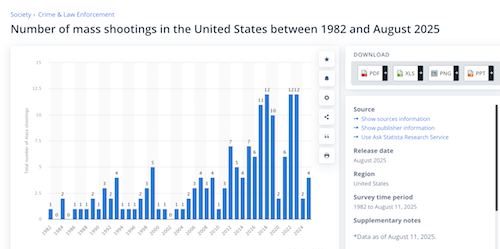
(Mass shootings in the United States from 1982 to 2025, per statista.com)
From 1982 to 2018, mass shootings in the United States increased by an annual average of 30.6%.
From 1982 to 2018, mass shootings in the United States increased by 1,100%, or by twelve times, from an all-time low 1 mass shooting to an all-time high 12 mass shootings.
From 1982 to 2000, mass shootings in the United States remained unchanged, at 1 per year.
From 1982 to 1999, mass shootings in the United States increased by an annual average of 23.5%.
From 1982 to 1999, mass shootings in the United States increased by 400%, from 1 to 5.
From 1982 to 1991, mass shootings in the United States increased by an annual average of 22.2%.
From 1982 to 1991, mass shootings in the United States increased by 200%, or by three times, from an all-time low 1 mass shooting to 3 mass shootings.
In 1982, per statista.com, there was an all-time low one mass shooting in the United States.
From 1990 to 2000, the homicide rate in England increased by 10.9%, from 1.01 per 100,000 to 1.12 per 100,000.
From 1990 to 2000, the 10.9% increase in the homicide rate in England was 19.2% less, or almost one fifth less than its 13.5% increase from 1980 to 1990.
Here we see that the technology-driven increase in homicide in England takes place within the larger context of an environment whose health was improving inexorably up to and beyond the end of the Mayan “long count” in 2012.
Here, from 1980 to 2000, despite the plague of technology-driven homicide, the health of the ether is still ultimately improving at a rate greater than that at which technology is able to degrade it.
Here’s a chart from macrotrends.net documenting the homicide rate in Germany from 1990 to 2021.
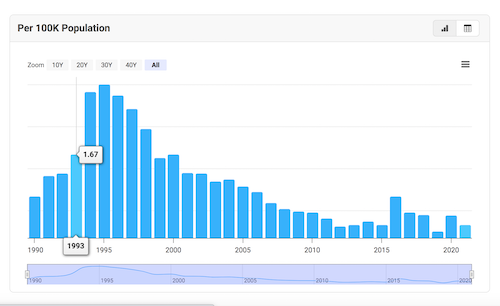
(The homicide rate in Germany from 1990 to 2021)
From 1990 to 2000, the 1.29% average annual increase in the homicide rate in England was 4.4% less than its 1.35% average annual increase from 1980 to 1990.
While technology-driven homicides increased during the time period from 1980 to 2000, the rate of that increase was slowing, going forward in time, blunted by the inexorable underlying improvement in the health of the ether on the way to the end of the Mayan “long count” in 2012.
In 1990, the homicide rate in England was 1.01 per 100,000.
From 1990 to 1995, the homicide rate in Germany increased by an annual average of 22.8%.
From 1990 to 1995, the homicide rate in Germany increased by 113.6%, or by more than two times, from 1.17 per 100,000 to a modern-era high 2.5 per 100,000, a level not seen since 1800 to 1824.
For those keeping score a doubling of the homicide rate in five years is not a normal thing.
Here, from 1990 to 1995, we see the signature of technology-driven homicide, increasing at a rate exponentially greater than the increase in the health of the ether during the same time period.
From 1990 to 1994, the 5.3% average annual increase in the homicide rate in Germany was 2,750% greater, or almost thirty times greater than its .2% average annual decrease from 1975 to 1990.
Homicides in Germany are increasing exponentially because the health of the ether was being degraded by the purportedly-harmless low-wavelength microwave radiation from what we collectively refer to as technology, including radio, radar, high tension power lines, microwave television transmissions, et al.
In 1990, the homicide rate in Germany was 1.17 per 100,000.
From 1991 to 2024, mass shootings in the United States decreased by an annual average of 1%.
From 1991 to 2024, mass shootings in the United States decreased by 33.3%, or by one third, from 3 to 2.
From 1991 to 1993, mass shootings in the United States increased by 33.3%, from three to four.
From 1991 to 1999, the 23.5% average annual increase in mass shootings in the United States was 5.9% greater than their 22.2% average annual increase from 1982 to 1991.
This is the signature of technology-driven homicide.
From 1991 to 2018, the 30.6% average annual increase in mass shootings in the United States was 37.8% greater, or more than one third greater than their 22.2% average annual increase from 1982 to 1991.
This is the signature of technology-driven homicide.
From 1991 to 1993, mass shootings in the United States increased by an annual average of 11.1%.
From 1991 to 1993, the 11.1% average annual increase in mass shootings in the United States was 63.7% less than their 30.6% average annual increase from 1982 to 1991.
While technology-driven mass shootings increased during the time period from 1982 to 1991, the rate of that increase was slowing, going forward in time, blunted by the inexorable underlying improvement in the health of the ether on the way to the end of the Mayan “long count” in 2012.
In 1991, per statista.com, there were three mass shootings in the United States.
In 1991, per fbi.gov, the homicide rate in the United States was 9.8 per 100,000.
Here, in 1991, after peaking in 1980, the homicide rate has decreased back to the rate of 1974.
In 1991, the homicide rate in Germany was 1.41 per 100,000.
In 1992, the homicide rate in Germany was 1.44 per 100,000.
From 1993 to 1999, mass shootings in the United States increased by an annual average of 4.2%.
From 1993 to 1999, mass shootings in the United States increased by 25%, from four to five.
From 1993 to 1999, the 4.2% average annual increase in mass shootings in the United States was 87.7% less, or more than three fourths less than their 33.3% average annual increase from 1991 to 1993.
Here, from 1993 to 1999, with the end of the Mayan “long count” in 2012 hoving into view, the health of the ether is improving at a rate exponentially greater than that at which technology is able to degrade it.
It was for this reason that what we collectively refer to as “wireless technology” was developed and deployed in the late 1990’s, along with the psychotic “chemtrail” operations which have since been largely abandoned.

(Cell towers)

(Chemtrails)
In 1993, per statista.com, there were four mass shootings in the United States.
In 1993, the homicide rate in Germany was 1.67 per 100,000.
From 1993 to 1994, the homicide rate in Germany increased by 44.3%, from 1.67 per 100,000 to 2.41 per 100,000.
From 1993 to 1994, the 44.3% increase in the homicide rate in Germany was 44,199% greater, or more than four hundred times greater than the .1% average annual increase in the homicide rate in Germany and Switzerland from 1850 to 1994.
This is the indelible signature of technology-driven homicide.
indelible - adjective - 1. (of ink, a pen, etc.) making marks that cannot be removed.
- not able to be forgotten.
From 1994 to 1995, the homicide rate in Germany increased by 3.7%, from 2.41 per 100,000 to 2.5 per 100,000, a modern-era high, and a level not seen since 1800 to 1824.
In 1994, the homicide rate in Germany was 2.41 per 100,000.
From 1995 to 2000, the homicide rate in Germany decreased by an annual average of 8.4%.
From 1995 to 2000, the homicide rate in Germany decreased by 42%, or by almost half, from a modern-era high of 2.5 per 100,000 to 1.45 per 100,000, a level last seen in 1992.
From 1995 to 1996, the homicide rate in Germany decreased by 5.2%, from a modern-era high of 2.5 per 100,000 to 2.37 per 100,000.
From 1995 to 2018, the homicide rate in Germany decreased by an annual average of 3%
From 1995 to 2018, the homicide rate in Germany decreased by 70%, or by almost three fourths, from a modern-era high of 2.5 per 100,000, a rate not seen since 1800 to 1824, to an all-time low .75 per 100,000.
From 1995 to 2017, per the crime survey for England and Wales, the rate of incidents of violence in England and Wales decreased by an annual average of 3.6%.
From 1995 to 2017, the respective 3% and 3.6% average annual decreases in the homicide rate in Germany and in the rate of incidents of violence in England and Wales were statistically very similar.
Homicides and incidents of violence are decreasing at very similar rates regardless of culture or geography because the health of the ether is inexorably improving, and moral and mental health vary directly with the health of the ether.
From 1995 to 2017, per the crime survey for England and Wales, the rate of incidents of violence in England and Wales decreased by 79.6%, or by more than three fourths, from 64 per 100,000, the greatest in history, to 13 per 1,000.
In 1995, per microtrends.net, the homicide rate in Germany was 2.5 per 100,000, a modern-era high, and a level not seen since 1800 to 1824.
In 1995, the rate of incidents of violence in England and Wales was 64 per 1,000, the greatest in history.
In 1995, the modern-era high-point of the homicide rate in Germany and the greatest rate of incidents of violence in England and Wales were simultaneous.
From 1996 to 1997, the homicide rate in Germany decreased by 6.8%, from 2.37 per 100,000 to 2.21 per 100,000.
In 1996, the homicide rate in Germany was 2.37 per 100,000.
From 1997 to 1998, the homicide rate in Germany decreased by 10.8%, from 2.21 per 100,000 to 1.97 per 100,000.
From 1997 to 1998, the 10.8% decrease in the homicide rate in Germany was 58.8% greater, or more than half again greater than its 6.8% decrease from 1996 to 1997.
Here, with the end of the Mayan “long count” in 2012 hoving into view, the health of the ether is improving at a rate exponentially greater than that of technology to degrade it.
In 1997, the homicide rate in Germany was 2.21 per 100,000.
From 1998 to 1999, the homicide rate in Germany decreased by 17.2%, from 1.97 per 100,000 to 1.63 per 100,000.
From 1998 to 1999, the 17.2% decrease in the homicide rate in Germany was 59.2% greater, or more than half again greater than its 10.8% decrease from 1997 to 1998.
From 1998 to 1999, the 59.2% positive variance in the decrease in the homicide rate in Germany versus 1997 to 1998 was .7% greater than its 58.8% positive variance from 1997 to 1998 versus 1996 to 1997.
Here, with the end of the Mayan “long count” in 2012 hoving into view, the health of the ether is improving at a rate exponentially greater than that of technology to degrade it.
In 1998, the homicide rate in Germany was 1.97 per 100,000.
From 1999 to 2025, mass shootings in the United States decreased by an annual average of .8%.
From 1999 to 2025, mass shootings in the United States decreased by 20%, from 5 to 4.
From 1999 to 2023, the homicide rate in Germany decreased by 64%, or by more than half, from 2.5 per 100,000, the greatest in history, to .9 per 100,000, a level last seen in 1950.
From 1999 to 2021, the homicide rate in Germany decreased by 66.8%, or by more than two thirds, from 2.5 per 100,000, the greatest in history, to .83 per 100,000, the fewest in history.
From 1999 to 2018, mass shootings in the United States increased by an annual average of 7.4%.
From 1999 to 2018, the 7.4% average annual increase in mass shootings in the United States was 68.5% less, or two thirds less than their 23.5% average annual increase from 1982 to 1999.
If my theory that moral and mental health varies directly with the health of the ether is correct, then here we see the ether inexorably improving, going forward in time, even despite the best efforts of technology to slow or stop it.
From 1999 to 2018, mass shootings in the United States increased by 140%, from five to an all-time high 12.
From 1999 to 2018, the 37.8% positive variance in the increase in mass shootings in the United States versus 1982 to 1991 was 540.6% greater, or almost six and a half times greater than its 5.9% variance from 1991 to 1999 versus 1982 to 1991.
Here, from 1991 to 2018, mass shootings in the United States are increasing exponentially thanks to the poisoning of the ether by the low-wavelength microwave radiation from what we collectively refer to as “technology”.
Moral and mental health vary directly with the health of the ether.
From 1999 to 2017, the homicide rate in Germany decreased by an annual average of 2.7%.
From 1995 to 2017, the homicide rate in Germany decreased by 60%, or by almost two thirds, from 2.5 per 100,000, a modern-era high, and a level not seen since 1800 to 1824, to 1 per 100,000.
From 1999 to 2013, the homicide rate in the United States decreased by an annual average of 1.3%.
From 1999 to 2013, the homicide rate in the United States decreased by 18.1%, from 5.5 per 100,000 to 4.5 per 100,000.
From 1999 to 2013, the health of the ether improved to the point were it was respectively in 1966 and 1958, and in 1912 and 1905.
From 1999 to 2012, mass shootings in the United States increased by an annual average of 3%.
From 1999 to 2012, the 3% average annual increase in mass shootings in the United States was 28.5% less, or almost one third less than their 4.2% average annual increase from 1993 to 1999.
Here, from 1999 to 2012, with the latter representing the end of the Mayan “long count”, the health of the ether is still improving at a rate greater than that of technology’s ability to degrade it.
From 1999 to 2012, mass shootings in the United States increased by 40%, or by almost one half, from five to seven.
From 1999 to 2003, the positive variance in the increase in the homicide rate in the United States versus Germany increased by an annual average of 7.5%.
From 1999 to 2003, the increase in the positive variance in the homicide rate in the United States versus Germany increased by an annual average of 7.5%.
From 1999 to 2003, the 7.5% positive variance in the increase in the homicide rate in the United States versus Germany was 368.8% greater, or more than four and a half times greater than its 1.6% average annual increase from 1950 to 1999.
What force, what influence is hyper-exponentially increasing the murderousness of citizens of the United States, versus citizens of Germany?
That would be the low-wavelength microwave radiation from what we collectively refer to as “technology”.
In 1999, the 237.4% positive variance in the homicide rate in the United States versus Germany was 76.5% greater, or more than three fourths greater than its 134.5% positive variance in 1950.
In 1999, the homicide rate in the United States of 5.5 per 100,000 was 237.4% greater, or more than three times greater than the homicide rate of 1.63 per 100,000 in Germany.
What force, what influence is making citizens of the United States more than three times as murderous as the Germans?
That would be the low-wavelength microwave radiation from what we collectively refer to as “technology”.
In 1999, per statista.com, there were 5 mass shootings in the United States.
In 1999, the homicide rate in Germany was 1.63 per 100,000.
In 1999, per fbi.gov the homicide rate in the United States was 5.5 per 100,000.
This is just below the rate of 5.6 per 100,000 documented in 1966, and prior to that in 1912.
In 1999, the homicide rate in the United States of 5.5 per 100,000 was 237.4% greater, or more than three times greater than the homicide rate of 1.63 per 100,000 in Germany.
In 1999, the 237.4% positive variance in the homicide rate in the United States versus Germany was 76.5% greater, or more than three fourths greater than its 134.5% positive variance in 1950.
What force, what influence is making citizens of the United States more than three times as murderous as the Germans? And why is that force increasing, going forward in time?
That would be the low-wavelength microwave radiation from what we collectively refer to as “technology”.
From 2000 to 2018, the 3% average annual decrease in the homicide rate in the United States was 64.3% less, or more than two thirds less than its 8.4% average annual decrease from 1995 to 2000.
Here, while the homicide rate is decreasing continuously from 1995 to 2018, thanks to the inexorable improvement in the underlying health of the ether, the rate of that decrease is slowing from 2000 to 2018, thanks to the low-wavelength microwave radiation from what we collectively refer to as “technology”.
From 2000 to 2017, murder cases in Germany decreased by an annual average of 1.5%.
From 2000 to 2017, murder cases in Germany decreased by 24.7%, or by almost one third, from 454 to 342.
In 2000, per statista.com, there were 930 murder cases in Germany.
From 2000 to 2005, the homicide rate in Germany decreased by an annual average of 4.6%.
From 2000 to 2005, the homicide rate in Germany decreased by 22.8%, from 1.67 per 100,000 to 1.29 per 100,000.
From 2000 to 2001, the homicide rate in Germany decreased by 13.1%, from 1.67 per 100,000 to 1.45 per 100,000.
From 2000 to 2001, the homicide rate in England increased by 33.9%, or by one third, from 1.12 per 100,000 to 1.5 per 100,000.
In 2000, per statista.com, there was one mass shooting in the United States.
In 2000, the homicide rate in England was 1.12 per 100,000.
In 2000, the homicide rate in Germany was 1.67 per 100,000.
In 2000, the homicide rate in Germany of 1.67 per 100,000 was 49.1% greater, or basically half again greater than the 1.12 per 100,000 homicide rate in England and Wales.
Why, here in 2000, are the Germans half again more murderous than the English?
In 2001, 3G connection-based networks were introduced.
From 2001 to 2002, the homicide rate in Germany decreased by .7%, from 1.45 per 100,000 to 1.44 per 100,000.
From 2001 to 2002, the .7% decrease in the homicide rate in Germany was 94.8% less, or almost infinitely less than its 13.1% decrease from 2000 to 2001.
Here at the beginning of the cell phone era, this is the signature of technology-driven homicide,
In 2001, the homicide rate in Germany was 1.45 per 100,000.
In 2001, the homicide rate in England and Wales was 1.5 per 100,000.
In 2001, the homicide rate of 1.5 per 100,000 in England and Wales was 3.4% greater than the homicide rate of 1.45 per 100,000 in Germany.
We’ve gone from the Germans being half again more murderous than the English in 2000 to the English being just slightly more murderous than the Germans in 2001.
Cell phone technology has leveled the playing field, causing otherwise-peaceable people to become one third more murderous in a single year.
Here’s a statista.com graphic of homicides in England and Wales from 2002 to 2025.
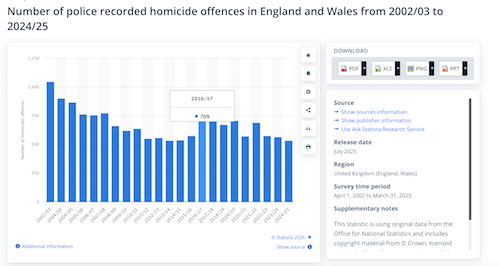
(Homicides in England and Wales from 2002 to 2025)
From 2002/03 to 2024/25, homicides in England and Wales decreased by 48.9%, or by basically half, or by 512 homicides, from 1,047 to 535.
From 2002/03 to 2023/24, homicides in England and Wales decreased by an annual average of 2.2%.
From 2002/03 to 2023/24, homicides in England and Wales decreased by 45.8%, or by almost half, or by 480 homicides, from 1,047 to 567.
From 2002/03 to 2016/17, homicides in England and Wales decreased by an annual average of 1.3%.
From 2002/03 to 2016/17, homicides in England and Wales decreased by 32.2%, from an all-time high 1,047 to 709.
In 2002/03, per statista.com, there were 1,047 homicides in England and Wales.
From 2002 to 2003, the homicide rate in Germany decreased by 6.22%, from 1.44 per 100,000 to 1.35 per 100,000.
In 2002, the homicide rate in Germany was 1.44 per 100,000.
From 2003 to 2024, the homicide rate in England and Wales decreased by 47%, or by almost half, from 17 per 100,000, the greatest in history, to 9 per 100,000, a rate last documented in 1973.
From 2003 to 2024, homicides in England and Wales decreased by 43.3%, or by almost half, from an all-time high 1,050 to 595.
For those keeping score, homicides in England and Wales decreased by more than a third from 1898 to 1916, then suddenly increased by almost one and a half times from 1916 to 1946, only to decrease again by half from 1946 to 1957, and then suddenly increased again by more than four times from 1957 to 2003, to the highest level in history. Then they decreased again by almost half from 2003 to 2024, to a level not seen since 1972.
Here, from 1896 to 2024, despite the plague of technology-driven homicide, the health of the ether is still ultimately improving at a rate greater than that at which technology is able to degrade it.
From 2003 to 2023, the increase in the positive variance in the homicide rate in the United States versus Germany increased by an annual average of 8%.
From 2003 to 2023, the 8% average annual increase in the positive variance in the homicide rate in the United States versus Germany was 6.6% greater than its 7.5% average annual increase from 1999 to 2023.
From 2003 to 2010, homicides in England and Wales decreased by an annual average of 3.5%.
From 2003 to 2010, homicides in England and Wales decreased by 24.8%, or by basically one fourth, from 1,050 to 790.
From 2003 to 2024, the homicide rate in the United States decreased by an annual average of .5%.
From 2003 to 2024, the homicide rate in the United States decreased by 10.7%, from 5.6 per 100,000 to 5 per 100,000.
From 2003 to 2005, homicides in London, England decreased by an annual average of 8.1%.
From 2003 to 2005, the .5% average annual decrease in the homicide rate in the United States was 93.8% less than the 8.1% average annual decrease in homicides in London, England.
Why?
The hyper-exponentially greater rate of adoption of technology by the populace of the United States during this time period.
From 2003 to 2005, homicides in London, England decreased by 16.2%, or by 35 homicides, from an all-time high 216 to 181.
In 2003, per theguardian.com, London, England had an all-time high 216 homicides.
The Guardian’s Vikram Dodd described it “the peak this century”.
Where “the peak” is a thinly-veiled reference to the High Places were H. neanderthalensis Ba’al worshippers practiced their rites of human sacrifice and cannibalism.
In 2003, there were (approximately) 1,050 homicides in England and Wales.
In 2003, the homicide rate in England and Wales was 17 per 100,000, the greatest in history.
In 2003, the homicide rate in Germany was 1.35 per 100,000.
In 2003, per bjs.ojp.gov, the homicide rate in the United States was 5.6 per 100,000.
In 2003, the homicide rate of 5.6 per 100,000 in the United States was 308.8% greater, or more than four times greater than the homicide rate of 1.37 per 100,000 in Germany.
In 2003, the 308.8% positive variance in the homicide rate in the United States versus Germany was 30% greater, or almost one third greater than its 237.4% positive variance in 1999.
What force, what influence is making citizens of the United States more than four times as murderous as the Germans? And why is that force increasing exponentially?
That would be the low-wavelength microwave radiation from what we collectively refer to as “technology”.
In 2004, the homicide rate in Germany was 1.37 per 100,000.
From 2005 to 2015, homicides in London, England decreased by an annual average of 3.4%,
From 2005 to 2015, the 3.4% average annual decrease in homicides in London, England was % less than their 8.1% average annual decrease from 2003 to 2005.
While homicides decreased continuously from 2003 to 2015 thanks to the inexorable underlying improvement in the health of the ether on the way to the end of the Mayan “long count” in 2012, the rate of that decrease was slowing, going forward in time, blunted by the collective Death energy generated by what we collectively refer to as “technology”.
From 2005 to 2015, homicides in London, England decreased by 33.7%, from 181 to 120.
In 2005, per theguardian.com, London, England had 181 homicides.
From 2005 to 2010, the homicide rate in Germany decreased by an annual average of 4.6%.
From 2005 to 2010, the 4.6% average annual decrease in the homicide rate in Germany was identical to its 4.6% average annual decrease from 2000 to 2005.
From 2005 to 2010, the homicide rate in Germany decreased by 23.2%, from 1.29 per 100,000, to .99 per 100,000.
In 2005, the homicide rate in Germany was 1.29 per 100,000.
In 2006, the homicide rate in Germany was 1.22 per 100,000.
In 2007, the iPhone was introduced.
In 2007, the homicide rate in Germany was 1.09 per 100,000.
In 2008, the homicide rate in Germany was 1.02 per 100,000.
In 2009, 4G, the fourth generation of cellular networks, was introduced.
In 2009, the homicide rate in Germany was .99 per 100,000.
From 2010 to 2015, the homicide rate in Germany decreased by an annual average of 3.2%.
From 2010 to 2015, the homicide rate in Germany by 16.1%, from .99 per 100,000, to .83 per 100,000, the fewest in history.
From 2010 to 2015, the 3.2% average annual decrease in the homicide rate in Germany was 30.4% less than its 4.6% average annual decrease from 2000 to 2010.
While homicides decreased continuously from 2000 to 2015 thanks to the inexorable underlying improvement in the health of the ether on the way into and through the end of the Mayan “long count” in 2012, the rate of that decrease was slowing, going forward in time, blunted by the collective Death energy generated by what we collectively refer to as “technology”.
In 2015, the homicide rate in Germany was .83 per 100,000.
In 2010, there were (approximately) 790 homicides in England and Wales.
In 2010, the homicide rate in Germany was .98 per 100,000.
In 2011, the homicide rate in Germany was .91 per 100,000.
From 2012 to 2018, the 7.4% average annual increase in mass shootings in the United States was 146.6% greater, or almost one and a half times greater than their 3% average annual increase from 1999 to 2012.
Here, from 2012 to 2018, wireless technology is degrading the health of the ether at a rate exponentially greater than that at which is improving.
From 2012 to 2015, mass shootings in the United States remained unchanged at seven per year.
In 2012, per statista.com, there were seven mass shootings in the United States.
In 2012, the homicide rate in Germany was .81 per 100,000, the lowest in history, in records going back to the year 1200. Magnificently, 2012 is the year that ended the Mayan “long count”.
From 2013 to 2025, the homicide rate in the United States decreased by an annual average of 3.9%.
From 2013 to 2025, the homicide rate in the United States decreased by 46.6%, or by almost half, from 4.5 per 100,000 to 2.4 per 100,000.
From 2013 to 2025, the 3.9% average annual decrease in the homicide rate in the United States was 200% greater, or three times greater than its 1.3% average annual derease from 1999 to 2013.
Given that moral and mental health vary directly with the health of the ether, the homicide rate in the United States is decreasing exponentially because the health of the ether is inexorably improving, despite the best efforts of technology to slow or stop it.
In 2013, the homicide rate in Germany was .83 per 100,000, the fewest in history.
In 2013, per fbi.gov, the homicide rate in the United States was 4.5 per 100,000.
This is just below the rate of 4.8 per 100,000 documented in 1958, and prior to that in 1905.
In 2013, the homicide rate of 4.5 per 100,000 in the United States was 442.1% greater, or more than five times greater than the rate of .83 per 100,000 in Germany.
In 2013, the 442.1% positive variance in the increase in the homicide rate in the United States versus Germany was 43.2% greater, or almost half again greater than its 308.8% positive variance in 2003.
What force, what influence is making citizens of the United States more than four times as murderous as the Germans? And why is that force increasing exponentially?
That would be the low-wavelength microwave radiation from what we collectively refer to as “technology”.
In 2014, the homicide rate in Germany was .87 per 100,000.
From 2015 to 2024, homicides in London, England decreased by an annual average of 1%.
From 2015 to 2024, homicides in London, England decreased by 9.1%, or by eleven homicides, from 120 to 109.
From 2015 to 2020, the homicide rate in Germany increased by an annual average of 2.6%.
Recapping: The homicide rate in Germany decreased by an annual average of 4.6% from 2000 to 2010, then, from 2010 to 2015, the 3.2% average annual decrease in the homicide rate was 30.4% less than its 4.6% average annual decrease from 2000 to 2010. Followed by this 2.6% average annual increase in the homicide rate in Germany from 2015 to 2020.
While the homicide rate in Germany decreased continuously from 2000 to 2015 thanks to the inexorable underlying improvement in the health of the ether on the way into and through the end of the Mayan “long count” in 2012, the rate of that decrease was slowing, going forward in time, blunted by the collective Death energy generated by what we collectively refer to as “technology”. Then, from 2015 to 2020, technology turned the tide and drove the homicide rate in Germany up by more than ten percent in just five years.
From 2015 to 2020, the homicide rate in Germany increased by 13.2%, from .83 per 100,000, the fewest in history, to .94 per 100,000.
From 2015 to 2019, homicides in London, England increased by an annual average of 6.9%.
From 2015 to 2019, homicides in London, England increased by 27.5%, or by almost one third, or by 33 homicides, from 120 to 153.
This is the signature of technology-driven homicide.
From 2015 to 2019, the 6.9% average annual increase in homicides in London, England was 165.3% greater, or more than one and a half times greater than the 2.6% average annual increase in the homicide rate in Germany.
Why? The greater density of Death energy in urban London versus the overall level of that Death energy across Germany, much of which is rural.
From 2015 to 2017, mass shootings in the United States increased by an annual average of 28.6%.
From 2015 to 2017, mass shootings in the United States increased by 57.1%, from seven to eleven.
From 2015 to 2017, the 28.6% average annual increase in mass shootings in the United States was 853.3% greater, or more than nine and a half times greater than their 3% average annual increase from 1999 to 2012.
This sudden, exponential increase in mass shootings in the United States from 2015 to 2017 documents the degradation of the health of the ether by wireless technology.
In 2015, per statista.com, there were seven mass shootings in the United States.
In 2015, per theguardian.com, London, England had 120 homicides.
In 2015, the homicide rate in Germany was .83 per 100,000.
From 2016/17 to 2024/25, homicides in England and Wales decreased by an annual average of 6.1%.
From 2016/17 to 2024/25, homicides in England and Wales decreased by 48.9%, or by basically half, from an all-time high 1,047 to 535.
From 2016/17 to 2024/25, the 6.1% average annual decrease in homicides in England and Wales was 369.2% greater, or more than four and a half times greater than their 1.3% average annual decrease from 2002/03 to 2016/17.
Here, despite the plague of technology-driven homicide, we see that the underlying health of the ether is still ultimately improving at a rate exponentially greater than that at which technology is able to degrade it.
From 2016/17 to 2023/2024, the 2.2% average annual decrease in homicides in England and Wales was 69.2% greater, or more than two thirds greater than their 1.3% average annual decrease from 2002/03 to 2016/17.
Here, moving into and through the end of the Mayan “long count” in 2012, the health of the ether is improving at a rate greater than that of technology’s ability to degrade it.
In 2016/17, per statista.com, there were 709 homicides in England and Wales.
In 2016, the homicide rate in Germany was 1.17 per 100,000.
From 2017 to 2024, murder cases in Germany decreased by an annual average of 5%.
From 2017 to 2024, murder cases in Germany decreased by 35%, from 342 to 222.
From 2017 to 2021, the homicide rate in Germany decreased by %, from .98 per 100,000 to .83 per 100,000.
From 2017/18 to 2020/21, homicides in England and Wales decreased by .3%, from 712 to 710.
In 2017, per statista.com, there were eleven mass shootings in the United States.
In 2017, there were 342 murder cases in Germany.
In 2017, the homicide rate in Germany was .98 per 100,000.
In 2017, the rate of incidents of violence in England and Wales was 13 per 1,000.
In 2017/18, there were 712 homicides in England and Wales.
From 2018 to 2024, murder cases in Germany decreased by an annual average of 12.6%,
From 2018 to 2024, murder cases in Germany decreased by 75.4%, from 901 to 222.
From 2018 to 2024, murder cases in Germany decreased by an annual average of 12.6%, from 901 to 222.
From 2018 to 2024, the 12.6% average annual decrease in murder cases in Germany was 6,200% greater, or more than sixty three times greater than their .2% average annual decrease from 2000 to 2018.
From 2018 to 2023, mass shootings in the United States remained unchanged, at an all-time high twelve.
From 2018 to 2021, the homicide rate in Germany decreased by 12.6%, from .95 per 100,000 to .83 per 100,000.
From 2018 to 2020, the homicide rate in Germany decreased by an annual average of .5%, from .95 per 100,000 to .94 per 100,000.
From 2018 to 2020, the homicide rate in Germany decreased by 1%, from .95 per 100,000 to .94 per 100,000.
From 2018 to 2019, the homicide rate in Germay decreased by 21%, from .95 per 100,000 to .75 per 100,000, the fewest in history.
From 2018 to 2019, the 21% decrease in the homicide rate in Germany was 20,899% greater, or more than two hundred times greater than its average annual decrease of .1% from 1200 to 2018.
From 2018 to 2019, the X% decrease in the homicide rate in Germany to its all-time low was 20,899% greater, or more than two hundred times greater than its % average annual decrease from it’s modern-era high in 1995 to 2018.
From 2018/19 to 2020/21, homicides in England and Wales decreased by an annual average of 7.5%.
From 2018/19 to 2020/21, homicides in England and Wales decreased by 15%, or by 101 homicides, from 674 to 573.
In 2018/19, per statista.com, England and Wales had 674 homicides.
In 2018, per statista.com, there were an all-time high twelve mass shootings in the United States.
In 2018, per statista.com, there were 901 murder cases in Germany.
In 2018, per microtrends.net, the homicide rate in Germany was .95 per 100,000, “a 3.39% decline from 2017”.
From 2019 to 2025, homicides in London, England decreased by an annual average of 6.1%.
From 2019 to 2025, homicides in London, England decreased by 36.6%, or by more than one third, or by 56 homicides, from 153 to 97.
The Guardian’s Vikram Dodd omitted the percentage decrease, and described it only-generally as “down from 153 in 2019”.
Those are examples of the propaganda technique known as “stonewalling”.
From 2019 to 2024, the 5.7% average annual decrease in homicides in London, England was 182.6% less, or almost three times less than their 6.9% average annual increase from 2015 to 2019.
Given that moral and mental health vary directly with the health of the ether, the homicide rate in the United States is decreasing exponentially because the health of the ether is inexorably improving, despite the best efforts of technology to slow or stop it.
From 2019 to 2024, homicides in London, England decreased by an annual average of 5.7%.
From 2019 to 2024, homicides in London, England decreased by 28.7%, or by almost one third, or by 44 homicides, from 153 to 109.
From 2019/20 to 2020/21, homicides in England and Wales decreased by 19.2%, or by 187 homicides, from 710 to 573.
From 2019/20 to 2020/21, the 19.2% decrease in homicides in England and Wales was 156% greater, or more than one and a half times greater than their 7.5% (average) decrease from 2018/19 to 2019/20.
Here, despite the plague of technology-driven homicide, we see that the underlying health of the ether is still ultimately improving at a rate exponentially greater than that at which technology is able to degrade it.
From 2019/20 to 2021/22, homicides in England and Wales decreased by an annual average of 1.3%.
From 2019/20 to 2021/22, homicides in England and Wales decreased by 2.5%, from 710 to 692.
In 2019/20, England and Wales had 710 homicides.
In 2009, 5G, the fifth generation of cellular networks, was introduced.
In 2019, per theguardian.com, London, England had 153 homicides.
In 2019, per microtrends.net, the homicide rate in Germany was .75 per 100,000, the fewest in history.
From 2019 to 2020, mass killings in the United States decreased by 2.4%, from an all-time high 41 to 40.
From 2020 to 2024, the homicide rate in Germany by %, from .94 per 100,000 to 2.7 per 100,000.
From 2020 to 2021, the homicide rate in Germany decreased by 11.7%, from .94 per 100,000 to .83 per 100,000.
From 2020 to 2021, the 11.7% decrease in the homicide rate in Germany was 2,240% greater, or more than twenty three times greater than its .5% average annual decrease from 2018 to 2020.
Despite the plague of technology-driven homicide, the health of the ether is still ultimately improving at a rate greater than that at which technology is able to degrade it.
From 2020 to 2021, the 11.7% decrease in the homicide rate in Germany was 1,850% greater, or more than nineteen times greater than its .6% average annual decrease from 1932 to 2023.
In 2020, per microtrends.net, the homicide rate in Germany was .94 per 100,000 “a 25.25% increase from 2019”.
In 2020/21, England and Wales had 573 homicides.
In 2020, per macrotrends.net, the U.K. homicide rate was 1.00 per million.
From 2021 to 2023, the homicide rate in Germany increased by an annual average of 4.2%.
From 2021 to 2023, the homicide rate in Germany increased by 8.4%, from .83 per 100,000 to .9 per 100,000.
From 2021/22 to 2022/23, homicides in England and Wales decreased by 16.7%, or by 116 homicides, from 692 to 576.
From 2021/22 to 2022/23, the 16.7% decrease in homicides in England and Wales was 1,184.6% greater, or more than twelve times greater than their 1.3% average annual decrease from 2019/20 to 2021/22.
From 2021/22 to 2022/23, the 1,184.6% positive variance in the decrease in homicides in England and Wales versus 2019/20 to 2021/22 was 659.4% greater, or more than seven and a half times greater than the 156% positive variance from 2019/20 to 2021 versus 2018/19 to 2019/20.
Here, despite the plague of technology-driven homicide, we see that the underlying health of the ether is still ultimately improving at a rate exponentially greater than that at which technology is able to degrade it.
In 2021/22, per statista.com, there were 692 homicides in England and Wales.
In 2021, per microtrends.net, the homicide rate in Germany was .83 per 100,000.
In 2022, per statista.com, there were an all-time high twelve mass shootings in the United States, tying the record of 12 set in 2018.
In 2022, per cdc.gov, there were 17,927 firearm homicides in the United States.
In 2022, per cdc.gov, there were 22,830 homicides in the United States.
In 2022, per cdc.gov, the homicide rate in the United States was 6.8 per 100,000.
From 2022 to 2023, per the Real-Time Crime Index, which compiles data from 570 law enforcement agencies, homicides in the United States decreased by 6%.
From 2022 to 2023, the homicide rate in the United States decreased by 13.3%, from 6.8% to 5.9%.
In 2022/23, per statista.com, there were 576 homicides in England and Wales.
In 2022/23, per ons.gov.uk, the homicide rate in England and Wales was 9.9 per million people.
From 2022/23 to 2023/24, homicides in England and Wales decreased by 1.6%, or by nine homicides, from 576 to 567.
From 2022/23 to 2023/24, the homicide rate in England decreased by 2%, from 9.9 per million to 9.7 per million.
From 2023 to 2025, mass shootings in the United States decreased by an annual average of 33.4%.
From 2023 to 2025, mass shootings in the United States decreased by 66.7%, or by two thirds, from twelve to four.
From 2023 to 2025, the 33.4% average annual decrease in mass shootings in the United States was 216.7% greater, or more than three times greater than their 2015 to 2017, the 28.6% average annual increase from 2015 to 2017.
From 2023 to 2025, the 33.4% average annual decrease in mass shootings in the United States was 4,075% greater, or more than twenty eight times greater than their .8% average annual decrease from 1999 to 2025.
Despite hysterical propaganda to the contrary, mass killings in the United States are decreasing hyper-exponentially, because the health of the ether is inexorably improving, and moral and mental health vary directly with the health of the ether.
In 2023, per statista.com, there were an all-time high twelve mass shootings in the United States, tying the total of 12 in 2022 and 2018.
In 2023, there were 299 homicides in Germany.
In 2023, per Wikipedia, the homicide rate in Germany was .9 per 100,000.
In 2023, per bjs.ojp.gov, the homicide rate in the United States was 5.9 per 100,000.
This is just above the 5.8 per 100,000 in 2006 and 2007, and just below the rate of 6.2 per 100,000 in 1967. It is identical to the rate of 5.9 per 100,000 documented in 1940 and 1910.
In 2023, the homicide rate in the United States of 5.9 per 100,000 was 555.6% greater, or more than six and a half times greater than the homicide rate of .9 per 100,000 in Germany.
Here, in 2023, what force, what influence is causing Americans to be more than six and half times as murderous as Germans?
That would be the low-wavelength microwave radiation from what we collectively refer to as “technology”.
In 2023, the 555.6% positive variance in the increase in the homicide rate in the United States versus Germany was 25.6% greater, or more than three fourths greater than its 442.1% positive variance in 2003.
In 2023, the 79.9% increase in the positive positive in the homicide rate in the United States versus germany was 136.3% greater, or more than two times greater than its 30% increase in 2003.
Here, from 2003 to 2023, what is causing the force that made citizens of the United States exponentially more murderous than the Germans to increase exponentially?
That would be the low-wavelength microwave radiation from what we collectively refer to as “technology”.
In 2023/24, per theguardian.com, London, England had 109 homicides.
In 2023/24, per statista.com, there were 567 homicides in England and Wales.
In 2023/24, the homicide rate in England and Wales was 9.7 per million, a rate last documented in 1973.
From 2023 to 2024, the homicide rate in Germany remained unchanged at .9 per 100,000.
From 2023 to 2024, the homicide rate in the United States decreased by 15.3%, from 5.9 per 100,000 to 5 per 100,000.
From 2023 to 2024, homicides in Germany decreased by 25.7%, from 299 to 222.
From 2023 to 2024, mass shootings in the United States decreased by 83.3%, or by more than three fourths, from an all-time high twelve to two.
From 2023 to 2024, the 15.3% decrease in the homicide rate in the United States was 155% greater, or one and a half times greater than its 6% decrease from 2022 to 2023.
From 2023 to 2024, the 25.7% decrease in homicides in Germany was 3,112% greater, or more than thirty two times greater than their .8% average annual decrease from 1932 to 2023.In 2023, there were 299 homicides in Germany.
From 2023 to 2024, the 83.3% decrease in mass shootings in the United States was 8,200% greater, or more than 83 times greater than their 1% average annual decrease from 1991 to 2024.
Given that moral and mental health vary directly with the health of the ether, the homicide rate in the United States is decreasing exponentially because the health of the ether is inexorably improving, despite the best efforts of technology to slow or stop it.
From 2023/24 to 2024/25, homicides in England and Wales decreased by 2.6%, or by 32 homicides, from 567 to 552.
From 2023/24 to 2024/25, the 2.6% decrease in homicides in England and Wales was 30% greater, or almost one third greater than their 2% decrease from 2022/23 to 2023/24.
Here, despite the plague of technology-driven homicide, we see that the underlying health of the ether is still ultimately improving at a rate exponentially greater than that at which technology is able to degrade it.
From 2023/24 to 2024/25, the homicide rate in England and Wales decreased by 13.4%, from 9.7 per million to 8.4 per million.
From 2023/24 to 2024/25, the 2.6% decrease in homicides in England and Wales was 18.18% greater, or almost one fifth greater than their 2.2% average annual decrease from 2002/03 to 2023/24.
Here, despite the plague of technology-driven homicide, we see that the underlying health of the ether is still ultimately improving at a rate exponentially greater than that at which technology is able to degrade it.
From 2023/24 to 2024/25, the 2.6% decrease in homicides in England and Wales was 62.5% greater, or almost two thirds greater than their 1.6% decrease from 2022/23 to 2023/24.
Here, despite the plague of technology-driven homicide, we see that the underlying health of the ether is still ultimately improving at a rate exponentially greater than that at which technology is able to degrade it.
In 2024, per statista.com, there were two mass shootings in the United States, matching the total from 2020, 2005, 1992, 1989 and 1984.
In 2024, per deutschland.de, 222 murders were recorded by the police in Germany.
In 2024, there were (approximately) 595 homicides in England and Wales, which is just below the 600 homicides last recorded there in 1972.
In 2024, the homicide rate in Germany was .9 per 100,000.
In 2024, per deutschland.de, the homicide rate in Germany was 2.7 per 100,000.
In 2024, per fbi.gov, the homicide rate in the United States was 5 per 100,000.
In 2024, the homicide rate in the United States of 5 per 100,000 was % greater than the homicide rate of 2.7 per 100,000 in Germany.
In 2024/25, per theguardian.com, London, England had 97 homicides, the fewest in history.
The Guardian’s Vikram Dodd omitted the percentage decrease, and described it only-generally as “down from 109” and “drops to lowest in more than a decade”.
Vikram did not offer any suggestion as to what might have caused the sudden, exponential decrease in homicides to the lowest level in history, nor did he mention that it was part of a wider trend taking place regardless of culture or geography.
Those are all examples of the propaganda technique known as “stonewalling”.
Vikram said “drops” because it is softer than “decreased”, but mostly as a thinly-veiled reference to the fallen Lord Lucifer.

(The fall of Lucifer, from “Paradise Lost”, by John Milton, 1667)
Here’s a picture of Vikram Dodd, in a Satanic-purple tie.

(The Guardian’s police and crime correspondent Vikram Dodd)
I have included Vikram Dodd’s picture so that you could get a better idea of what a generational Satanist Freemason of marginal influence looks like.
They are all related to one another through the maternal bloodline. Generational Satanists comprise between twenty and thirty percent of the populace, and are hiding in plain sight in every city, town and village on Earth.
It’s how the few have controlled the many all the way back to Babylon, and before.
But they say that the hardest part of solving a problem is recognizing that you have one.
Don Croft used to say “Parasites fear exposure above all else”.
How long do you think that these people have left in power, now?
Please consider doing what you can to help speed the transition.
In 2024/25, per ons.gov.uk, there were 518 homicides in England and Wales, the lowest figure since current police recording practices began in YE March 2003. and roughly the same rate documented in the early 1970’s again again in the mid to late 1940’s.
In 2024/25, the homicide rate in England and Wales was 8.4 per million, which is roughly the same rate last documented in 1970.
In 2024/25, the homicide rate in London, England was 10.7 per million, the lowest since comparable records began in 1997.
From 2024 to 2025, homicides in England and Wales decreased by 6.2%, from 552 to 518.
From 2024 to 2025, the 6.1% (average) decrease in homicides in London, England was 7% greater than their 5.7% average annual decrease from 2019 to 2024.
Here, over a decade after the end of the Mayan “long count” in 2012, homicides in London, England are decreasing exponentially.
From 2024 to 2025, homicides in London, England decreased by 11%, or by 12 homicides, from 109 to 97.
From 2024 to 2025, per the Real-Time Crime Index, which compiles data from 570 law enforcement agencies, homicides in the United States decreased by 15%.
Please note that the Real-Time Crime Index did not provide any statistics to back up their assertion.
From 2024 to 2025, the homicide rate in the United States decreased by 45.8%, or by almost half, from 5 per 100,000 to 2.71 per 100,000.
From 2024 to 2025, the unsubstantiated 15% decrease in homicides in the United States claimed by the Real-Time Crime Index, which compiles data from 570 law enforcement agencies was 69% less, or more than two thirds less than the 48.5% decrease in the homicide rate in the United States per fbi.gov.
The Real-Time Crime Index’s claim that homicides in the United States decreased by 15% is brazenly false.
As you can see, they’re using an example of the propaganda technique known as “the Big Lie”.
I have exposed their duplicity by using what was known in the old days as “fact checking”.
From 2024 to 2025, the 239.9% positive variance in the decrease in the homicide rate in the United States versus 2023 to 2024 was 54.8% greater, or more than half again greater than its 155% positive variance from 2023 to 2024 versus 2022 to 2023.
From 2024 to 2025, the 11% decrease in homicides in London, England was 93% greater, or almost two times greater than their 5.7% average annual decrease from 2019 to 2024.
From 2024 to 2025, the 52% decrease in the homicide rate in the United States was 239.9% greater, or almost three and a half times greater than its 15.3% decrease from 2023 to 2024.
From 2024 to 2025, the 11% decrease in homicides in London, England was 1,000% greater, or eleven times greater than their 1% average annual decrease from 2015 to 2024.
Here, despite the plague of technology-driven homicide, we see that the underlying health of the ether is still ultimately improving at a rate exponentially greater than that at which technology is able to degrade it.
From 2024 to 2025, the 45.8% decrease in the homicide rate in the United States was 3,716.7% greater, or more than thirty eight times greater than its 1.2% average annual decrease from 1980 to 2024.
From 2024 to 2025, the 45.8% decrease in the homicide rate in the United States was 9,060% greater, or more than ninety one times greater than its .5% average annual decrease from 2003 to 2024.From January 2024 to October 2024, there were 7,369 murders in the United States.
Given that moral and mental health vary directly with the health of the ether, the homicide rate in the United States is decreasing exponentially because the health of the ether is inexorably improving, despite the best efforts of technology to slow or stop it.
In 2025, per statista.com, there were four mass shootings in the United States, matching the total from 2014, 2009, 2007 and 1993.
In 2025, per consumershield.com, the homicide rate in the United States was 2.71 per 100,000.
This is a rate documented only one time previously, in 1904.
On December 2, 2025, northeastern.edu’s James Alan Fox said “U.S. mass killings are down in 2025, though experts say it’s likely a return to typical levels”.
When, in fact, from 2023 to 2025, the 33.4% average annual decrease in mass shootings in the United States was 4,075% greater, or more than twenty eight times greater than their .8% average annual decrease from 1999 to 2025.
As you can see, James is using an example of the propaganda technique known as “the Big Lie”.
I have exposed his duplicity, along with that of his employer, Northeastern University, by using what was known in the old days as “fact checking”.
Per Northeastern University, “James Alan Fox has published 18 books, dozens of journal and magazine articles, and hundreds of freelance columns in newspapers around the country.”
Here’s a picture of Northeastern University’s James Alan Fox, where the image is constructed to focus attention on his left eye, and where he’s using his left hand to make a purportedly-secret Masonic “gesture of recognition”.

(Northeastern University’s James Alan Fox)
Now here’s a 19th Century depiction of a Freemason using the same purportedly-secret “gesture of recognition” that Northeastern University’s James Alan Fox is in the photo immediately above.

(19th Century depiction of a Freemason using a purportedly-secret “gesture of recognition”.)
For any Coincidence theorists lingering in the readership, here’s a second image of Mr. Fox, in a Satanic-purple tie, where the image is constructed to focus attention on his left eye, where he’s widening his eyes to simulate honesty, and where using the same purportedly-secret Masonic “gesture of recognition” that we’ve reviewed in the two images immediately above.

(Northeastern University’s James Alan Fox)
To maintain current programming levels, stop reading immediately and affirm “oh, some people just like to talk with their hands.”
The image features his left eye because, to bloodline-linked Illuminists like Northeastern University’s James Alan Fox, the left eye is the “eye of Will” or the “eye of Horus”.
‘The right eye is the Eye of Ra and the left is the Eye of Horus’.”
From “Freemasonry - Religion And Belief - The 3rd Temple”
Facebook: “Welcome to the Left-Hand-Path-Network, where Satanism is not about worship, but it’s study.”
I have included James Alan Fox’s picture so that you could get a better idea of what a generational Satanist Freemason of marginal influence looks like.
They are all related to one another through the maternal bloodline.
Generational Satanists comprise between twenty and thirty percent of the populace, and are hiding in plain sight in every city, town and village on Earth.
It’s how the few have controlled the many all the way back to Babylon, and before.
But they say that the hardest part of solving a problem is recognizing that you have one.
Don Croft used to say “Parasites fear exposure above all else”.
How long do you think that these people have left in power, now?
Please consider doing what you can to help speed the transition.
Jeff Miller, Honolulu, HI, January 20, 2026
If you’d like to be added to this free mailing list, or know someone who would be, please send me a note at [email protected].