A Study of Suicide in the United States from 1900 to 2024
“The day science begins to study non-physical phenomena, it will make more progress in one decade than in all the previous centuries of its existence.”
― Nikola Tesla
The following chart from the National Center for Health Statistics documents the suicide rate in the United States from 1900 to 2021.
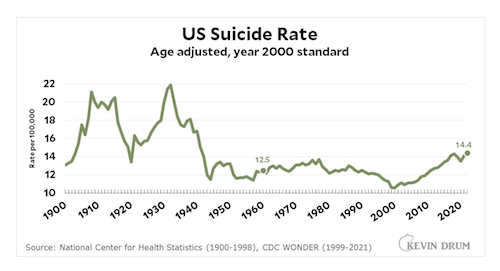
(U.S. Suicide rate, 1900 to 2021)
In 1900, per the National Center for Health Statistics, the suicide rate in the United States was 13 per 100,000.
From 1933 to 2024, the suicide rate in the United States decreased by an annual average of .24%.
From 1933 to 2024, the suicide rate in the United States decreased by 19.4%, from 17 per 100,000 to 13.7 per 100,000.
In 1933, per www.alabamapublichealth.gov, the suicide rate in the United States was 17 per 100,000.
From 1950 to 1960, the suicide rate among males in the United States decreased by 5.7%, from 21.2 per 100,000 to 20 per 100,000.
From 1950 to 1960, the suicide rate among females in the United States remained unchanged at 5.6 per 100,000.
From 1950 to 1960, the unchanged rate of suicide among females in the United States was infinitely greater than the 5.7% average annual decrease among males.
In 1950, per infoplease.com, the suicide rate in the United States was 13.2 per 100,000.
In 1950, per statista.com, the suicide rate among males in the United States was 21.2 per 100,000.
In 1950, per statista.com, the suicide rate among females in the United States was 5.6 per 100,000.
In 1950, the suicide rate among males in the United States of 21.2 per 100,000 was 278.6% greater, or almost four times greater than the rate of 5.6 per 100,000 among their female peers.
In 1960, per infoplease.com, the suicide rate in the United States was 13.2 per 100,000.
In 1960, per statista.com, the suicide rate among females in the United States was 5.6 per 100,000.
In 1960, per statista.com, the suicide rate among males in the United States was 20 per 100,000.
In 1960, the suicide rate among males in the United States of 20 per 100,000 was 251.7% greater, or almost more than three and a half times greater than the rate of 5.6 per 100,000 among their female peers.
In 1960, the 251.7% positive variance of suicides in males versus females in the United States was 9.7% less than its 278.6% positive variance in 1950.
In the ten years from 1950 to 1960, suicides among females in the United States increased at a rate almost ten percent greater than they did among males.
From 1960 to 1970, the suicide rate among females in the United States increased by an annual average of 3.2%
From 1960 to 1970, the suicide rate among females in the United States increased by 32.2%, or by almost one third, from 5.6 per 100,000 to 7.4 per 100,000.
From 1970 to 2000, the positive variance in suicide in males versus females in the United States increased by 96.2%, or by almost two times, from 167.6% greater to 328.8% greater.
From 1970 to 1990, the suicide rate among females in the United States decreased by an annual average of 1.8%.
From 1970 to 1990, the suicide rate among females in the United States decreased by 35.1%, from 7.4 per 100,000 to 4.8 per 100,000.
From 1970 to 1990, the suicide rate among males in the United States increased by an annual average of .43%.
From 1970 to 1990, the .43% average annual increase in the suicide rate among males in the United States was 123.8% greater than the 1.8% decrease among their female peers.
This statistic documents the fact that, in the twenty years from 1970 to 1990, suicides among males in the United States increased exponentially, while they decreased among females.
From 1970 to 1990, the suicide rate among males in the United States increased by 8.6%, from 19.8 per 100,000 to 21.5 per 100,000.
In 1970, the suicide rate among males in the United States of 19.8 per 100,000 was 167.6% greater, than the rate of 7.4 per 100,000 among their female peers.
In 1970, the 167.6% positive variance of suicides in males versus females in the United States was 33.4% less, or one third less than its 251.7% positive variance in 1960.
In 1970, the suicide rate among males in the United States of 19.8 per 100,000 was 167.6% greater, than the rate of 7.4 per 100,000 among their female peers.
In 1970, the 33.4% decrease in the positive variance of suicides in males versus females in the United States versus 1960 was 244.3% greater, or almost three and a half times greater than the 9.7% decrease in 1960 versus 1950.
This statistic documents the fact that, in the twenty years from 1950 to 1970, suicides among females in the United States increased at a rate exponentially greater than they did among males.
In 1970, per statista.com, the suicide rate among females in the United States was 7.4 per 100,000.
In 1970, per infoplease.com, the suicide rate in the United States was 13.2 per 100,000.
In 1970, per statista.com, the suicide rate among males in the United States was 19.8 per 100,000.
From 1990 to 2000, the suicide rate among females in the United States decreased by an annual average of 1.5%.
From 1990 to 2000, the suicide rate among males in the United States decreased by 18.6%, from 21.5 per 100,000 to 17.5 per 100,000.
From 1990 to 2000, the suicide rate among females in the United States decreased by 14.6%, from 4.8 per 100,000 to 4.1 per 100,000.
From 1990 to 2000, the 14.6% average annual decrease in the suicide rate rate among females in the United States was 21.5% less, or one fifth less than the 18.6% average annual decrease among their male peers.
Here, from 1990 to 2000, while suicides in the United States are decreasing significantly among both males and females, the rate of that decrease is almost one fifth slower in females than was among males.
That’s the impact of low-wavelength microwave radiation.
I say that because, per Ronald W. Kay in 1994, increased electromagnetic radiation from storms drove suicide among women, while it decreased suicide among men. Further, from January 1980 to December 1992, per Gordon and Berk, there was a correlation between suicides and average storm activity in South Africa. The effect was 400% greater, or five times greater in females (P <.005) than males (P <.025).
Ergo, the decrease in suicide among women in the United States from 1990 to 2000 was over one fifth smaller among women than it was among men because of the increasing concentration of low wavelength microwave radiation in the environment in the United States during that time period.
In 1990, per statista.com, the suicide rate among females in the United States was 4.8 per 100,000.
In 1990, per statista.com, the suicide rate among males in the United States was 21.5 per 100,000.
From 1999 to 2004, the suicide rate among 45-to-54-year-olds in the U.S. increased by 20%.
Ann Haas, the research director of the American Foundation for Suicide Prevention said in comment “That is certainly a break from trends of the past”, and offered no suggestion as to why it might have taken place.
Here’s a picture of the grinning Ann Haas.

(Ann Haas, Research Director, American Foundation for Suicide Prevention)
grin - verb - (intransitive, dated) To show the teeth, like a snarling dog.
(transitive) To grin as part of producing a particular facial expression, such as a smile or sneer.
He grinned a cruel sneer when I begged him to stop.
I’ve included Ann Haas’ picture so you could get a better idea of what a generational Satanist of marginal influence looks like.
They are all related to one another through the maternal bloodline. They comprise roughly twenty percent of the populace, and are hiding in plain sight in every city, town and village on Earth. It’s how the few have controlled the many all the way back to Babylon, and before.
But they say that the hardest part of solving a problem is recognizing that you have one.
Don Croft used to say “Parasites fear exposure above all else”.
From 2000 to 2010, the suicide rate among males in the United States increased by an annual average of 1.3%.
From 2000 to 2010, the suicide rate among females in the United States increased by an annual average of 2.2%.
From 2000 to 2010, the 2.2% average annual increase in the suicide rate among females was 69.2% greater, or more than two thirds greater than the 1.3% average annual increase among their male peers.
That’s the impact of low-wavelength microwave radiation.
I say that because, per Ronald W. Kay in 1994, increased electromagnetic radiation from storms drove suicide among women, while it decreased suicide among men. Further, from January 1980 to December 1992, per Gordon and Berk, there was a correlation between suicides and average storm activity in South Africa. The effect was 400% greater, or five times greater in females (P <.005) than males (P <.025).
Ergo, the increase in suicide among women in the United States from 2000 to 2010 was over two thirds greater among women than it was among men because of the increasing concentration of low wavelength microwave radiation in the environment in the United States during that time period.
From 2000 to 2010, the suicide rate among females in the United States increased by 21.9%, from 4.1 per 100,000 to 5 per 100,000.
From 2000 to 2010, the suicide rate among males in the United States increased by 13.1%, from 17.5 per 100,000 to 19.8 per 100,000.
In 2000, per statista.com, the suicide rate among males in the United States was 17.5 per 100,000.
In 2000, per statista.com, the suicide rate among females in the United States was 4.1 per 100,000.
In 2000, the suicide rate among males in the United States of 17.5 per 100,000 was 328.8% greater, or more than four times greater than the rate of 4.1 per 100,000 among their female peers.
From 2010 to 2018, the suicide rate among females in the United States by an annual average of 3%.
From 2010 to 2018, the 3% average annual increase in the suicide rate among females in the United States was 36.3% greater, or more than one third greater than its 2.2% average annual increase from 2000 to 2010.
From 2010 to 2018, the suicide rate among males in the United States by an annual average of 1.8%.
From 2010 to 2018, the 1.8% average annual increase in the suicide rate among males in the United States was 38.4% greater, or more than one third greater than its 1.3% average annual increase from 2000 to 2010.
From 2010 to 2018, the respective 36.3% and 38.4% positive variances in the increase in suicide among males and females in the United States versus 2000 to 2010 were statistically very similar.
Here, from 2010 to 2018, suicides in the United States are increasing exponentially at very similar rates among both males and females because the low wavelength microwave radiation from technology is degrading the health of the ether, and moral and mental health vary directly with the health of the ether.
From 2010 to 2018, the 3% average annual increase in the suicide rate among females in the United States was 66.6% greater, or two thirds greater than their 1.8% average annual increase among their male peers.
That’s the impact of low-wavelength microwave radiation.
I say that because, per Ronald W. Kay in 1994, increased electromagnetic radiation from storms drove suicide among women, while it decreased suicide among men. Further, from January 1980 to December 1992, per Gordon and Berk, there was a correlation between suicides and average storm activity in South Africa. The effect was 400% greater, or five times greater in females (P <.005) than males (P <.025).
Ergo, the increase in suicide among women in the United States from 2010 to 2018 was two thirds greater among women than it was among men because of the increasing concentration of low wavelength microwave radiation in the environment in the United States during that time period.
From 2010 to 2018, the suicide rate among males in the United States increased by 15.1%, from 19.8 per 100,000 to 22.8 per 100,000.
From 2010 to 2018, the suicide rate among females in the United States increased by 24%, from 5 per 100,000 to 6.2 per 100,000.
In 2010, per statista.com, the suicide rate among females in the United States was 5 per 100,000.
In 2010, per statista.com, the suicide rate among males in the United States was 19.8 per 100,000.
In 2010, the suicide rate among males in the United States of 19.8 per 100,000 was 296% greater, or basically four times greater than the rate of 5 per 100,000 among their female peers.
From 2018 to 2022, the suicide rate among females in the United States decreased by an annual average of 1.2%.
From 2018 to 2022, the suicide rate among males in the United States increased by an annual average of .23%.
From 2018 to 2022, the .23% average annual increase in the suicide rate among males in the United States was 119.2% greater than the 1.2% average annual decrease among females.
From 2018 to 2022, the suicide rate among males in the United States increased by .9%, from 22.8 per 100,000 to 23 per 100,000.
From 2018 to 2022, the suicide rate among females in the United States increased by 4.8%, from 6.2 per 100,000 to 5.9 per 100,000.
In 2017, per the CDC, the suicide rate in the United States was 14.0 per 100,000.
In 2018, per statista.com, the suicide rate among females in the United States was 6.2 per 100,000.
In 2018, per the CDC, the suicide rate in the United States was 14.2 per 100,000 population.
In 2018, per statista.com, the suicide rate among males in the United States was 22.8 per 100,000.
In 2020, per the CDC, the suicide rate in the United States was 13.5 per 100,000 population.
In 2021, per the CDC, the suicide rate in the United States was 14.1 per 100,000 population.
In 2021, per the CDC, 48,183 people died by suicide in the United States.
From 2022 to 2023, the suicide rate in the United States increased by 3.5%, from 14.2 per 100,000 to 14.7 per 100,000.
From 2022 to 2023, the suicide rate among males in the United States decreased by .87%, from 23 per 100,000 to 22.8 per 100,000.
From 2022 to 2023, the suicide rate among females in the United States remained unchanged at 5.9 per 100,000.
In 2022, per statista.com, the suicide rate among males in the United States was 5.9 per 100,000.
In 2022, per statista.com, the suicide rate among males in the United States was 23 per 100,000.
In 2022, per U.S. News, the suicide rate in the United States was 14.2 per 100,000.
From 2023 to 2024, the suicide rate in the United States decreased by 6.8%, from 14.7 per 100,000 to 13.7 per 100,000.
From 2023 to 2024, the 6.8% decrease in the suicide rate in the United States was 292.4% greater, or almost four times greater than its 3.5% increase from 2022 to 2023.
From 2023 to 2024, the 6.8% decrease in the suicide rate in the United States was 2,733% greater, or more than twenty eight times greater than its .24% average annual decrease from 1933 to 2024.
Given that moral and mental health vary directly with the health of the ether, then here from 2023 to 2024 we see a hyper-exponential improvement in the health of the ether coming out of the end of the Mayan “long count” in 2012.
From 1933 to 2024, the suicide rate in the United States decreased by an annual average of .24%.
In 2023, per asfp.org, the suicide rate among white females in the United States was 6.53 per 100,000, greater than any other ethnic group.
In 2023, per asfp.org, the suicide rate among white males in the United States was 25.23 per 100,000, greater than any other ethnic group.
In 2023, per asfp.org, the suicide rate amonge females in the United States was 5.9 per 100,000.
In 2023, per U.S. News, the suicide rate in the United States was 14.7 per 100,000.
In 2023, per asfp.org, the suicide rate among males in the United States was 22.8 per 100,000.
In 2023, the suicide rate among males in the United States of 22.8 per 100,000 was 286.4% greater, or almost four times greater than the rate of 5.9 per 100,000 among females.
In 2024, per AI, the suicide rate in the United States was 13.7 per 100,000.
Jeff Miller, Honolulu, HI, February 19, 2026
If you’d like to be added to this free mailing list, or know someone who would be, please send me a note at [email protected].