“Nothing you do, no attempt you make, no plan you form, but I hear of it, see it, and know it all.”
From “In Catilinam I”, by Marcus Tullus Cicero, 106 B.C. to 43 B.C.
Breakthroughs in this article include:
The “hobbit” hominid Homo floresiensis of Indonesia, Esau of the Christian Bible, and the Menehune of Hawaii are all one and the same.
The original inhabitants of Rapa Nui, or Easter Island were the short-statured, red-haired, red-skinned “hobbit” hominid H. floresiensis of Indonesia.
If Samoa experienced an exponential increase in its population around 1000 years ago, and if modern Samoans come largely from the Austronesian lineage, and if that Austronesian lineage includes Taiwan, and if 95% of Taiwanese are of Han Chinese ancestry, and if H. neanderthalensis had light skin, and if the Chinese have light skin, and if the Chinese have the highest admixture of Neanderthal DNA on Earth, then, in 1000 A.D., the light-skinned H. Neanderthalensis Chinese invaded the Island of Samoa and subjected its H. floresiensis inhabitants to their cult of human sacrifice and cannibalism.
If the light-skinned H. Neanderthalensis Chinese invaded and subjected the island of Samoa in 1000 A.D., and if the light-skinned Samoan Pa’ao invaded Hawaii and introduced human sacrifice and cannibalism there in 1100 A.D., then, in 1100 A.D., the H. Neanderthalensis Samoan Pa’ao invaded the island of Hawaii and subjected its H. floresiensis inhabitants to the Neanderthal/Chinese cult of human sacrifice and cannibalism.
Three of the light-skinned H. neanderthalensis Hawaiian haole propagandists in this study documented disseminating disinformation on the the short-statured, red-haired, red-skinned “hobbit” hominid H. floresiensis of Indonesia called by the Hawaiians Homo floresiensis Manahune/Menehune, namely Martha Warren Beckwith, Abraham Fornander and William Hyde Rice, were all children of prominent religious personages.
Summary
From 190,000 B.C. to 50,000 B.C., the distinct and separate species of human known as H. floresiensis produced core and flake stone tools in at Liang Bua cave in western Flores, Indonesia.
Archeologist Gregory Forth found their bones and their tools in 2004 on the Flores island in Indonesia, in a cave called Lia Ula, located not far above old Ua (Rua) on the northern slope of the volcanoe Ebu Lobom.
Those tools were found intermingled with the bones and teeth of extinct dwarf elephant relative, the Stegodon, along with other extinct fauna.
Cut marks were found on the Stegodon bones.
On October 14, 2022, paleoanthropology.com’s Peter Brown said in comment " ‘Cut marks’ that I have seen on Stegodon bones (2003-2005) could have resulted from processes other than hominin use of stone tools".
Can you see how Peter used the general “other processes”, without elaborating further?
He’s queasily accusing the person who found them, Gregory Forth, of fabricating the evidence.
That is an example of the propaganda technique known as “stonewalling”.
Here’s a picture of Peter Brown.

(Anthropologist Peter Brown)
I have included his picture so that you could get a better idea of what a generational Satanist Freemason of marginal influence looks like.
They are all related to one another through the maternal bloodline. Generational Satanists comprise between twenty and thirty percent of the populace, and are hiding in plain sight in every city, town and village on Earth. It’s how the few have controlled the many all the way back to Babylon, and before.
But they say that the hardest part of solving a problem is recognizing that you have one.
Don Croft used to say “Parasites fear exposure above all else”.
How long do you think that these people have left in power, now?
Please consider doing what you can to help speed the transition.
As early as 190,000 B.C., the short-statured, red-skinned, red-haired species of human known as Homo floresiensis lived on Flores island just east of Java in the South China sea.
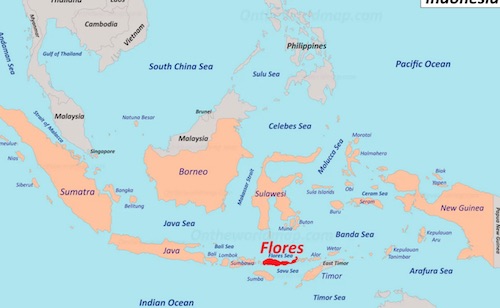
(Flores Island)
From 50,000 B.C. to present, on Flores island in Indonesia, the distinct and separate species of human known the “hobbit” hominid known as Homo floresiensis was short-statured, had red skin, and was covered in red hair.
In 2006 B.C., in the Christian Bible’s Book of Genesis, Esau, one of Isaac’s two twin sons, is described as being small, having red skin, and being covered in red hair.
In 1500 B.C., the large, hyper-aggressive, white-skinned Homo neanderthalensis Chinese invaded Indonesia, and H. floresiensis retreated to the Island of Samoa, to be rebranded by establishment history as “the Lapita”.
In 1,500 B.C., the “Lapita” people were the first people to colonize the Polynesian island of Samoa, per Wikipedia.
“The Lapita people are believed to have originated from the northern Philippines, either directly, via the Mariana Islands, or both”.
- Wikipedia
“The Lapita people were originally from Taiwan and other regions of East Asia. … Lapita pottery has been found from New Guinea eastward to Samoa”.
- Wikipedia
“>95%) of Taiwanese are of Han Chinese ancestry”
If 95% of the current population of Taiwan is Chinese, and if the Lapita people were originally from Taiwan and other regions of East Asia, and if Lapita pottery has been found from New Guinea eastward to Samoa, then the H. neanderthalensis Chinese drove the H. floresiensis “Lapita” people out of Taiwan in 1500 B.C., at which time the Lapita fled to Samoa.
In 1500 B.C. the H. floresiensis Lapita people, who originated in the Philippines and the Mariana Islands, migrated 2,182 miles due east to Samoa, when the H. Neanderthalensis Chinese invaded and drove them out.
They would remain on Samoa in peace for almost two thousand years, until the Neanderthal came after them, once again, occupied Samoa, and drove the Lapita out once again.
If the Lapita people were originally from Taiwan and other regions of East Asia, and the short-statured species of human known as Homo floresiensis is from East Asia, then the Lapita people may have been members of the distinct and separate species of human known as Homo floresiensis.
To make matters even more interesting, the original inhabitants of Rapa Nui, or what has been rebranded by the West as “Easter Island” are also from Taiwan and East Polynesia.
The Rapa Nui people are of Polynesian descent, originating from East Polynesia, with ancestral links to Island Southeast Asia (Taiwan) as part of the broader Austronesian expansion.
- Wikipedia
If the Lapita people were members of the distinct and separate species of short-statured human known as Homo floresiensis, and if those H. floresiensis Lapita people were originally from Taiwan and other regions of East Asia, and the original inhabitants of Rapa Nui were from Taiwan and Southeast Asia, then the original inhabitants of Rapa Nui were the short-statured H. florensiensis.
Once this article on the Menehune is complete, I’m obviously going to have to integrate it into my existing history of Rapa Nui, and rename that document “The Actual History of the South Pacific”.
In 300 A.D., the large, hyper-aggressive, white-skinned Homo neanderthalensis invaded the Marquesas, and H. floresiensis fled to Hawaii and Rapa Nui. In Hawaii, they would later be rebranded by a later wave of Homo neanderthalensis invaders from Tahiti as “Menehune”.
The original inhabitants of the Marquesas islands came from Samoa.
“The Marquesas Islands were colonized by seafaring Polynesians as early as 300 AD, thought to originate from Samoa.”
- Wikipedia
In the Wikipedia entry immediately above, the general “Polynesians” obscures “Lapita”, which further obscures the distinct and separate species of short-statured human known as Homo floresiensis.
Meanwhile, “thought to” sows the seed of doubt that the original inhabitants of Samoa did, in fact, come from the Marquesas.
These are all examples of the propaganda technique known as “stonewalling”.
Here we may infer that, in 300 A.D., after dwelling in peace on the Island of Samoa for almost two thousand years, the short-statured Homo floresiensis “Lapita” people fled Samoa for the Marquesas when the H. Neanderthalensis Chinese once again invaded and drove them out.
These short-statured Homo floresiensis “Lapita” people would later be rebranded as “the Menehune”, who were the first inhabitants of Hawaii, and further, who came from the Marquesas islands.
“Menehune were the first people. And I’m a descendant of the first people. My great grandmother traces her lineage back to the Marquesas.”
- Aletha Kaohi, 88, of Waimea Valley on Kaua’i, quoted in “Chasing Menehune”, by Christine Hitt, July 1, 2019
The quote immediately above documents the fact tha the short-statured Menehune came to the Big Island of Hawaii from the Marquesas islands.
If the Lapita people traveled from Samoa to the Marquesas islands in 300 A.D., and the Menehune came to the Big Island of Hawaii from the Marquesas islands, then the Lapita people and the short-statured Menehune are one and the same.
The Marquesas Islands are the ancestral homeland from which Polynesians first settled Hawaii, migrating by voyaging canoe over 2,000 miles across the Pacific, a journey requiring immense skill in ocean navigation.
- AI, December 2025
In the AI quote immediately above, the general “Polynesians” obscures “Lapita”, which further obscures the distinct and separate species of short-statured human known as Homo floresiensis.
Those are examples of the propaganda technique known as “stonewalling”.
In 300 A.D., after dwelling in peace on the Island of Samoa for almost two thousand years, the short-statured Homo floresiensis “Lapita” people fled Samoa for the Marquesas when the H. Neanderthalensis Chinese once again invaded and drove them out.
These short-statured Homo floresiensis “Lapita” people would later be rebranded by the Tahitians in Hawaii as “the Menehune”.
If the short-statured Homo floresiensis “Lapita” people fled Samoe for the Marquesas in 300 A.D., and the short-statured Menehune came to the Big Island of Hawaii from the Marquesas, then the Homo floresiensis “Lapita” people and the short-statured Menehune are one and the same.
“Hawaiian, any of the aboriginal people of Hawaii, descendants of Polynesians who migrated to Hawaii in two waves: the first from the Marquesas Islands, probably about ad 400; the second from Tahiti in the 9th or 10th century.”
- britannica.com, October 2025
In the AI quote immediately above, the general “Polynesians” obscures “Lapita”, which further obscures the distinct and separate species of short-statured human known as Homo floresiensis.
From 800 A.D. to 1820 A.D., in Hawaii, the Menehune were described as being short-statured, having red-skin, and being covered with red hair.
Homo floresiensis, Esau of the Christian Bible and the Menehune of Hawaii were all one and the same.
I surmise that, at one time, H. floresiensis was widespread, but was later driven back by H. neanderthalensis to the remote enclave of Indonesia, and then back further and further still across the Pacific, until the race was almost enirely eradicated.
The red-skinned Picts of Scotland may have been of the same species. The Picts were so-called because they were covered in tattoos. The polynesians are also covered in tattoos.
(research)
From 400 A.D. to 1200 A.D., the original short-statured Homo floresiensis inhabitants of Rapa Nui lived there undisturbed.
From 400 A.D. to 800 A.D., the short-statured Homo floresiensis Menehune, rebranded by establishment history as “the Lapita”, lived on the Big Island of Hawaii undisturbed.
In 400 A.D., after less than a hundred years of peaceful existence there, the short-statured Homo floresiensis “Lapita” people fled the Marquesas islands for Hawaii and Rapa Nui when the Neanderthal “Tahitians” invaded. In Hawaii, they would later be rebranded by the Tahitians as “Menehune”.
They would remain undisturbed in Hawaii for roughly four hundred years, until Tahitians fleeing the invading Chinese death cult escaped to what is now the Big Island of Hawaii in the year 800. Yet this first wave of Tahitian immigrants was peacable, and even intermarried with the short-statured Homo floresiensis “Lapita” people.
“Lua-Nu’u (Second Nuʻu, or cycle of time), called also Kane-hoa-lani, Lalo-kona, Pua-Nawao, Ku-ma-menehune, Ku-hooia, Ku-iiki, is placed as the twelfth name from Nuʻu on the Kumuhonua genealogical line. Lake (Kupulupulu) and Pili are his sons. Maui, Kanaloa and Kaneapua, Waha-nui, and Makaliʻi are the mythical names belonging to his period. The names Pua-Nawao and Ku-mamenehune refer to him as ancestor of the Nawao and Menehune people”.
From “Hawaiian Mythology - Mu and the Menehune People”, by Martha Beckwith, 1940
In 400 A.D., Lua-Nu’u was the first documented ancestor of the Manahune/Menehune people in Hawaii.
The short-statured Homo floresiensis Mahanhune lived in the forest, mostly on bananas.
Linguists estimate Easter Island’s first inhabitants arrived around AD 400, and most agree that they came from East Polynesia.
In the pbs.org passage immediately above, the general “Easter Island’s first inhabitants” obscures the specific “Homo floresiensis”.
From 800 A.D. to 1100 A.D., the Tahitian Hawaiians lived peaceably with the short-statured Homo floresiensis “Lapita” people. It is probable that it was during this time period that the term “Manehune” (later Menehune) began to be applied to Homo floresiensis.
The Tahitians who fled to Hawaii to escape the Chinese Death cult on Tahiti referred to the short-statured Homo floresiensis “Lapita” people as “Manahune”, which is a Tahitian word for “commonor”. Ironically, it was the name which the invading Chinese death cult had bestowed upon the Tahitians who would not integrate into the Death cult.
“I believe the Menehune name was given by the Tahitians. Tahitians were once known as Manahune. They bore the name with honor until Tahiti was conquered by warriors from [the Society Island of] Ra‘iātea, when it took on a very different meaning.”
- Aletha Kaohi, 88, of Waimea Valley on Kaua’i, quoted in “Chasing Menehune”, by Christine Hitt, July 1, 2019
(Research the invasion of Tahiti from Ra’iatea)
In 800 A.D., a first migration to Hawaii of Tahitians who fled to escape the Chinese Death cult on Tahiti arrived on the Big Island of Hawaii. These Tahitian invaders rebranded H. floresiensis as the Manahune (later mistranslated as Menehune).
When the second wave of the H. neanderthalensis invasion of Hawaii from Tahiti took place in 1100 A.D., the Manahune retreated to the Hawaiian island of Kaua’i. Their ongoing genocide of H. floresiensis would continue until the last Manahune was eradicted sometime in the mid-1800’s.
It would take the H. neanderthalensis Chinese until 1200 A.D. to get to Rapa Nui, when they would cut down all the trees and enslave, kill, cook and eat the island’s original Homo floresiensis inhabitants.
“This alludes to another theory passed down by Hawaiians, which was that the Menehune, part of the first wave of settlers in Hawai‘i, was a race of people that lived in the islands prior to the 11th century, before the second wave of Polynesian migration from Tahiti.”
From “Chasing Menehune”, by Christine HItt, July 1, 2019
The quote immediately above tells us that, in 1000 A.D., the Chinese death cult sent hundreds of canoes from Tahiti to the Big Island of Hawaii, and implemented what would later be called “the kapus”.
From 1000 to 1796, the short-statured Homo floresiensis “Manahune/Menehune” lived in the remote mountain valleys on the island of Kaua’i for a period of almost eight hundred years.
In 1000 A.D., the H. Neanderthalensis Chinese invaded Samoa. They have been rebranded by Establishment history as “Austronesians”.
“Samoa experienced an exponential jump in its population around 1000 years ago. Modern Samoans come largely from the Austronesian lineage (people in Taiwan, Island Southeast Asia, Micronesia, coastal New Guinea, Island Melanesia, Polynesia, and Madagascar)”.
www.auckland.ac.nz
“>95%) of Taiwanese are of Han Chinese ancestry”
If Samoa experience an exponential increase in its population around 1000 years ago, and modern Samoans come largely from the Austronesian lineage, and if the Austronesian lineage includes Taiwan, and if 95% of Taiwanese are of Han Chinese ancestry, then the H. Neanderthalensis Chinese invaded and subjected Samoa in 1000 A.D.
In 1100 A.D., the Chinese death cult on Samoa and Tahiti, rebranded by establishment history as “the Tahitians”, sent an invasion fleet to Hawaii and invaded and subjected both the expatriate Tahitian Hawaiians and the Menehune.
In 1100 A.D., the invading H. Neanderthalensis Chinese put in place a kapu which said that only Ali’i could eat bananas. Establishment history as since rebranded them as “the Tahitians”.
It was an edict put in place to literally starve the Homo florensiensis Manahune/Menehune people.
In 1100 A.D., Pa’ao arrived from Samoa and introduced human sacrifice and the kapus. He was, tellingly, light-skinned - a member of the distinct and separate species of human which we know as Homo neanderthalensis.
Patient readers will recall that the greatest admixture of Neanderthal DNA on Earth is found among the Chinese. It is 40% greater than the admixture found in Europeans.
“Hawaiian oral tradition speaks of Pa’ao, a light-skinned kahuna who came to the islands in the tenth century, some say from Upolu, Samoa, others from Kahiki”
- manoaheritagecenter.org, 2022
The Chinese have porcelain-white skin.
If Samoa experience an exponential increase in its population around 1000 years ago, and modern Samoans come largely from the Austronesian lineage, and if the Austronesian lineage includes Taiwan, and if 95% of Taiwanese are of Han Chinese ancestry, then the H. Neanderthalensis Chinese invaded and subjected Samoa in 1000 A.D.
If Pa-ao was a light-skinned chinaman from Samoa, then the Chinese introduced human sacrifice and cannibalism to Hawaii in 1100 A.D.
He is also said to have brought a “pure” chief to rule over Hawaiʻi, deposing the tyrant and highest ranking chief, Kapawā.
Pa‘ao landed in Puna, Hawai‘i and built his first heiau as a temple for his god and named the heiau Aha‘ula. It was a luakini heiau (a temple for human sacrifice).
From Puna Pa‘ao went to Kohala, landing at Pu‘uepa where he built the luakini human sacrifice heiau called Mo‘okini dedicated to the war god Ku.
The following image is of a carving of the god Ku.
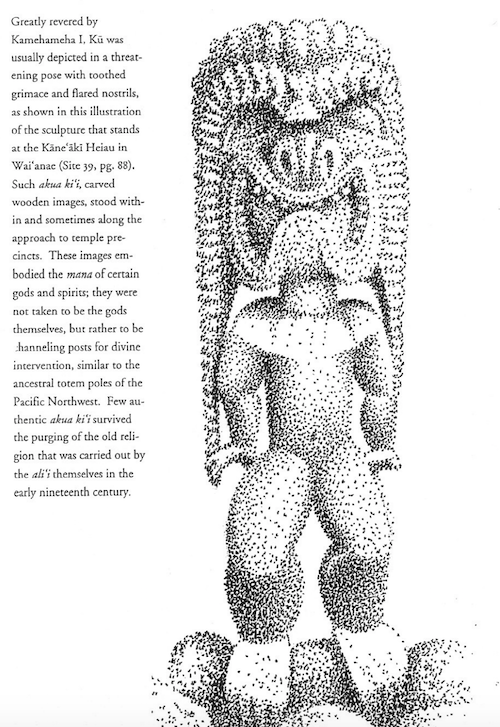
(Ku)
The following image is of a 2025 Toyota.

(2025 Toyota)
Can you see the grim, angry Tiki face? It is described above as a “toothed grimace”.
In 1100 A.D., in response to the Chinese/Tahitian Death cult’s invasion of the Big Island of Hawaii, 500,000 Manahune fled to Kaua’i.
“According to Akina in Rice’s Hawaiian Legends, half a million Menehune gathered on the island of Kaua‘i for a great exodus after the king of the Menehune, worried by the number of marriages between Hawaiian women and Menehune men, decided it was best to leave to keep their race pure.”
From “Chasing Menehune”, by Christine HItt, July 1, 2019
In the quote immediately above, the propagandist Christine Hitt plays the ruse that the Menehune fled the Big Island for Kaua’i of their own volition. When, in fact, they were fleeing to avoid genocide at the hands of the invading Tahitian death cult in 1000 A.D.
I have exposed the duplicity of Christine Hitt by using what was known in the old days as “fact checking”.
“Manahune is mixed in our bloodline. The real name is Manahune, not Menehune. Menehune is what the first settlers called them, because they couldn’t say or pronounce it. But Manahune is the real name. I don’t have much stories, I just know a lot about them. Basically, the Manahune was the Marquesas people, the first people of Hawai‘i. So the Hawaiians never liked them, so they got shunned out to the mountains.”
A Hawaii from Wainiha Valley, Kaua’i, from “Chasing Menehune”, by Christine Hitt, July 1, 2019
Here, the unnamed resident of the Wainiha Valley on Kaua’i is quoted as saying “never liked them” and “they got shunned out to the mountains”, where author Christine Hitt obscures the racially-driven genocide of the Lapita people by the invading Tahitians.
Since we know that the Hawaiians and the Menehune got married and had children, we also know that it was the second wave of Tahitian immigration in 1000 A.D., namely that of the Chinese Death cult under the fair-skinned Pa’ao, which genocided as many Manahune as they could, while the remaining few fled out into the mountains.
“Stories of the Mu and Menehune forest livers, who are placed by genealogists among the early generations of Kumuhonua’s offspring, also include a legend of migration, but generally not pictured as compulsory, away from their home on this group to some mysterious other world of the gods…It is hazardous to attempt to untangle from these legends the actual interweaving of fancy and fact which has gone to their shaping”.
From “Hawaiian Mythology - Mu and Menehune People”, by Martha Beckwith, 1940
In the passage immediately above, Martha Beckwith refers to the Manahune’s fleeing of genocidal Tahitian invaders in Mil-speak as a “non-compulsory migration” and then piles on with “legendary”, which states that it did not, in fact, take place.
Here, Margaret bravely avers that the Manahune went to an only-generally defined “some mysterious other world of the gods”.
Now, that’s fairy tale writing at its best.
“Beckwith was born in Wellesley Heights, Massachusetts, to George Ely and Harriet Winslow (née Goodale) Beckwith, both schoolteachers, before the family moved to Maui, Hawaii, where they had relatives descended from early missionaries.”
- Wikipedia
Descended from early missionaries, I see.
Here we have learned that the Hawaiian haole propagandist disseminating disinformation on the Homo florensiensis Manahune/Menehune, namely Martha Beckwith, was descended from prominent religious personages.
“For he who makes the fairest show makes the most deceit”.
From “Pericles”, by William Shakespeare, 1609
Here’s a picture of Martha Beckwith, where the image is blatantly constructed to focus attention on her left eye.

(Martha Beckwith)
The photo emphasizes her left eye because, to bloodline-linked Illuminists like Martha Warren Beckwith, left eye is the “eye of Will” or the “eye of Horus”.
‘The right eye is the Eye of Ra and the left is the Eye of Horus’.”
From “Freemasonry - Religion And Belief - The 3rd Temple”
Facebook: “Welcome to the Left-Hand-Path-Network, where Satanism is not about worship, but it’s study.”
I have included her picture so that you could get a better idea of what a generational Satanist Freemason of marginal influence looks like.
They are all related to one another through the maternal bloodline. Generational Satanists comprise between twenty and thirty percent of the populace, and are hiding in plain sight in every city, town and village on Earth. It’s how the few have controlled the many all the way back to Babylon, and before.
But they say that the hardest part of solving a problem is recognizing that you have one.
Don Croft used to say “Parasites fear exposure above all else”.
How long do you think that these people have left in power, now?
Please consider doing what you can to help speed the transition.
In April 1796, having already conquered the other Hawaiian Islands, King Kamehameha I launched his first invasion attempt on Kauai, and embarked upon the genocide of the short-statured Homo floresiensis Menehune people. By 1820, there were only sixty five of them left.
In 1820, the first Hawaiian census by Kaua‘i King Kaumuali‘i recorded 2,000 people living in Wainiha Valley on the island of Kaua‘i, sixty-five of whom were described as menehune.
From this we may infer that, by the mid-1800’s, all of the Homo floresiensis “Manahune” had all been exterminated or had died.
In 1877, Abraham Fornander published “Fornander’s Ancient History of the Hawaiian People to the Times of Kamehameha I”.
In it, he described the wild Mu race who lived on bananas in the forest in Hawaii as “a people of large size, wild, [who] did not associate with kanakas (men).”
Here, the propagandist Fornander brazenly inverts the short-statured Homo floresiensis as “a people of large size”, and omits the fact that they were red-skinned and completely covered in hair.
Those are examples of the propaganda technique known as “stonewalling”.
“In this book, Fornander suggested that the Polynesians were related to people from ancient India. He believed they had traveled over many years through India and the Malay islands into the Pacific islands.”
In the passage immediately above, the general “Polynesians” obscures the first inhabitants of Hawaii, namely the short-statured Homo floresiensis Manahune/Menehune, and then, for good measure, obscures the Tahitian origin of the current population of Hawaii, and the Chinese origin of those Tahitians.
Those are all examples of the propaganda technique known as “stonewalling”.
“Abraham Fornander was born in Öland, Sweden, on November 4, 1812. His parents were Anders and Karin Fornander. For most of his early years, his father, who was a clergyman, taught him at home.”
In the passage immediately above, we can see how the Hawaiian haole propagandist Abraham Fornander was the son of a clergyman.
We have now learned that both of the Hawaiian haole propagandists featured in this article, namely Martha Warren Beckwith and Abraham Fornander, were both the progeny of prominent religious personages.
To add grist to the mill, I would note that, in 1847, at the age of 35, Fornander became a citizen of the Kingdom of Hawaii. He promised his loyalty to King Kamehameha III. In the same year, he married Pinao Alanakapu in Honolulu. She was a Hawaiian chiefess from Molokai.
Here we can see how a generational Satanist Freemason from a religious family in Sweden ended up marrying into a Hawaiian, a.k.a. Tahitian royal bloodline.
On October 8, 1909, “Moolelo O Ka Lahui Kanaka I Kapaia Menehune, O Kauai”, by James H. Kuhau Kaiwi was published in Ka Nupepa Kuokoa XLVI, no. 41.
Kaiwi was a native of Niumalu on the southeast coast of the island of Kauai in the Hawaiian Islands. Niumalu is the location of the Menehune fishpond.
(Expand)
“The race of people called Menehune were very small, and were said to be shorter than the knees of Nā-ipu-ʻālehu. If these words of the ancients are true, then that means that these people were indeed tiny; perhaps dwarf-like, short in stature. Yet they had strong bodies, sturdy with bulging muscles. Their skin was red, with lots of hair and snubbed-noses, and they had bulging foreheads that were covered in hair. Their large eyes were covered by their big eyebrows. They were said to be very frightening to gaze upon, something that was better off not looking at.”
From “Moolelo O Ka Lahui Kanaka I Kapaia Menehune, O Kauai”, by James H. Kuhau Kaiwi, kupa of Niumalu, published in Ka Nupepa Kuokoa XLVI, no. 41, October 8, 1909
In the passage above, Kaiwi documents the Menehune as being red-skinned, and covered in hair of a color that is unmentioned.
Now, we’ll compare that description with a description of Isaac’s son, Esau from the book of Genesis in the Christian Bible.
"19 These are the generations of Isaac, Abraham’s son: eAbraham fathered Isaac, 20 and Isaac was forty years old when he took Rebekah, fthe daughter of Bethuel the Aramean of gPaddan-aram, hthe sister of Laban the Aramean, to be his wife. 21 And Isaac prayed to the LORD for his wife, because she was barren. And ithe LORD granted his prayer, and Rebekah his wife conceived. 22 The children struggled together within her, and she said, “If it is thus, why is this happening to me?” So she went to inquire of the LORD. 23 And the LORD said to her,
“Two nations are in your womb, and two peoples from within you shall be divided; the one shall be stronger than the other, the older shall serve the younger.”
24 When her days to give birth were completed, behold, there were twins in her womb. 25 The first came out red, all his body like a hairy cloak, so they called his name Esau. 26 Afterward his brother came out with ohis hand holding Esau’s heel, so phis name was called Jacob.4 Isaac was sixty years old when she bore them."
Genesis 25:19-26, from “The King James Bible”, 1611
In the passage immediately above, “the one shall be stronger than the other” is a tight-lipped admission that Esau was short-statured, a dwarf.
And “the older shall serve the younger” is a very general description of how Homo floresiensis was hunted to the ends of the Earth.
We have now learned that the short-statured, red-skinned, hairy Esau, the short-statured, red-skinned, hairy Homo floresiensis and the short-statured Menehune are all one and the same.
“Their dwelling place was in the mountains, above Waimea, near perhaps to a place known as Waikeki. Their conversation was a kind of murmer like the growl of a dog; they were loud-voiced in their laughter, and were in perfect accord in all their undertakings and manner of living. They subsisted on bananas, silver-sides and shrimps.”
From “Story of the Race of Menehunes of Kauai”, by Thomas G. Thrum, in Hawaiian Annual, 1921
“The watercourse of Kikiola, above the Waimea River, was built by this race of Menehune who dug the course and laid the stones smooth and tight in the following manner. It is said that they stood in line from above the waterhead of the watercourse of Kikiola to below Polihale, and by the hand of this menehune and that each stone was passed this long distance of five or six miles, and yet the course was completed and the water turned in by morning in its construction.”
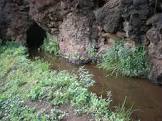
(The menehune watercourse of Kikiola on the Waimea River on Kaua’i)
In 1923, the Hawaiian haole politician William Hyde Rice, whom patient readers will recall was one of the key drivers of the overthrow of the Hawaiian monarchy, published “Hawaiian Legends”.
“William Hyde Rice was born at Honolulu, Hawaii on July 23, 1846. His father was William Harrison Rice (1813–1862), and mother was Mary Sophia Hyde; both were Protestant missionary teachers at Oahu College.”
- Wikipedia
We’ve now learned that all three of the Hawaiian haole propagandists featured in this article disseminating disinformation on the Homo floresiensis Manahune/Menehune, namely Martha Warren Beckwith, Abraham Fornander and William Hyde Rice, were all children of parents who were prominent religious personages.
For those struggling with cognitive dissonance, I would reinforce the fact that Rice also helped overthrow the Hawaiian monarchy.
“Cognitive dissonance is the discomfort that we feel when our deeply held beliefs do not match what is evident in reality”.
From “The Oxford Learner’s Dictionary”
Here’s a picture of William Hyde Rice, in his uniform as Governer of Kaua’i, from whence the Manahune/Menehune had long since been eradicated.
(William Hyde Rice, in his uniform as Governor of Kaua’i)
I have included William Hyde Rice’s picture so that you could get a better idea of what a generational Satanist Freemason of significant influence looks like.
They are all related to one another through the maternal bloodline. Generational Satanists comprise between twenty and thirty percent of the populace, and are hiding in plain sight in every city, town and village on Earth. It’s how the few have controlled the many all the way back to Babylon, and before.
But they say that the hardest part of solving a problem is recognizing that you have one.
Don Croft used to say “Parasites fear exposure above all else”.
How long do you think that these people have left in power, now?
Please consider doing what you can to help speed the transition.
“Both Thrum and Rice also published descriptive accounts of the Menehunes’ appearance based on two translated stories. One was by J.A. Akina, who described them as a small people of about two to three feet tall, and the other was from J. H. Kaiwi, whose grandparents described them as short and round, with red skin, hairy bodies, and big eyes hidden by bushy eyebrows. Early 20th century tales like these are what shaped the modern image of Menehune”.
From “Chasing Menehune”, by Christine Hitt, published on fluxhawaii.com on July 1, 2019
In the passage immediately above, propagandist Christine Hitt deviously plays the ruse that a red-skinned, short-statured, hairy menehune was only a modern conception.
She has, however, helpfully elucidated for me how one of the key players in the overthrow of the Hawaiian monarchy also played a role in spreading propaganda which obscured the true nature of the Manahune/Menehune. That is, despite the fact that Christine’s article didn’t make any mention that part of William Hyde Rice’s history.
That’s an example of the propaganda technique known as “stonewalling”.
ruse - noun - a way of doing something or of getting something by cheating someone. synonym trick
Here’s a picture of Christine Hitt, against a Satanic-purple bedspread, and where the image is blatantly constructed to focus attention on her left eye.

(Christine Hitt)
The photo emphasizes her left eye because, to bloodline-linked Illuminists like Christine, the left eye is the “eye of Will” or the “eye of Horus”.
‘The right eye is the Eye of Ra and the left is the Eye of Horus’.”
From “Freemasonry - Religion And Belief - The 3rd Temple”
Facebook: “Welcome to the Left-Hand-Path-Network, where Satanism is not about worship, but it’s study.”
I have included her picture so that you could get a better idea of what a generational Satanist Freemason of marginal influence looks like.
They are all related to one another through the maternal bloodline. Generational Satanists comprise between twenty and thirty percent of the populace, and are hiding in plain sight in every city, town and village on Earth. It’s how the few have controlled the many all the way back to Babylon, and before.
But they say that the hardest part of solving a problem is recognizing that you have one.
Don Croft used to say “Parasites fear exposure above all else”.
How long do you think that these people have left in power, now?
Please consider doing what you can to help speed the transition.
In 1940, Martha Beckwith published “Hawaiian Mythology- Mu and Menehune people”.
In it she said “On the Kumuhonua genealogy Lua-nuʻu becomes the father by a slave wife of the Nawao (The wild people), a Mu race living on bananas in the forest (ka-lahui-mu-ai-maia-a-laau-haeleele)”.
Here we can see why the invading Tahitians put in place a kapu that said only Ali’i could eat bananas. It was an edict put in place to literally starve the Homo floresiensis Manahune/Menehune people.
In 1951, the Bernice P. Bishop Museum in Honolulu, Hawaii published Katherine Luomala’s “The Menehune of Polynesia and Other Mythical Little People of Oceania”.
I think that we can all agree that calling a people documented on an official census “mythical” is psychotic.
psychotic - adjective - affected or caused by a serious mental illness, in which somebody sees or hears things that are not there, or believes things that are not true.
Katherine is using conscious deception while using the firmness of purpose that goes with complete honesty.
Here’s a picture of Polynesian folklorist Katherin Luomala, Ph.D.

(Polynesian folklorist Katherine Luomala, Ph.D)
I have included Katherine’s picture so that you could get a better idea of what a generational Satanist Freemason of marginal influence looks like.
They are all related to one another through the maternal bloodline. Generational Satanists comprise between twenty and thirty percent of the populace, and are hiding in plain sight in every city, town and village on Earth. It’s how the few have controlled the many all the way back to Babylon, and before.
But they say that the hardest part of solving a problem is recognizing that you have one.
Don Croft used to say “Parasites fear exposure above all else”.
How long do you think that these people have left in power, now?
Please consider doing what you can to help speed the transition.
“The process has to be conscious, or it would not be carried out with sufficient precision, but it also has to be unconscious, or it would bring with it a feeling of falsity and hence of guilt. Doublethink lies at the very heart of Ingsoc, since the essential act of the Party is to use conscious deception while retaining the firmness of purpose that goes with complete honesty. To tell deliberate lies while genuinely believing in them, to forget any fact that has become inconvenient, and then, when it becomes necessary again, to draw it back from oblivion for just so long as it is needed, to deny the existence of objective reality and all the while to take account of the reality which one denies—all this is indispensably necessary.”
― From “1984”, by George Orwell, 1949
In 1984, an Oxford-educated Archeologist named Gregory Forth was working in the Nage region of central Flores island just west of Java.
He documented accounts of “ebu gogo”, small, hairy and non-human bipeds that were supposed to have survived until, several generations previously, the Nage had exterminated a group of these hairy creatures inhabiting a cave called Lia Ula, located not far above old Ua (Rua) on the northern slope of the volcanoe Ebu Lobo.
The cave of Liu Ula is exactly where he’d find their physical remains twenty years later, in 2004.
Forth thought that these reports were striking in their “apparent historicity and matter-of-fact quality.”
In 2004, Archeologist Gregory Forth found the bones and stone tools of H. florensiensis tools in a cave called Lia Ula, located not far above old Ua (Rua) on the northern slope of the volcanoe Ebu Lobom.
Those tools were found intermingled with the bones and teeth of extinct dwarf elephant relative, the Stegodon, along with other extinct fauna.
Cut marks were found on the Stegodon bones.
In 2019, Jan TenBruggencate published “Menehune Mystery: The Original Tales and Origins of the Myth”.
Where “Myth” clearly states that the Menehune have no basis in reality.
myth - noun - a widely held but false belief or idea.
He’s desperate to keep you from recognizing that the Menehune are the distinct and separate species of human known as Homo floresiensis, which has been all but eradicated by H. neanderthalensis, whose ranks include the late propagandist Jan TenBruggencate.
Here’s a picture of Jan, where he has his left hand to his chin in a purportedly-secret Masonic “gesture of recognition”.

(Jan TenBruggencate)
Now here’s a picture of prominent Illuminist Will Smith, with his hand to his chin in the same purportedly-secret Masonic “gesture of recognition” that Jan TenBruggencate is using in the picture immediately above.

(Will Smith)
I have included Jan’s picture so that you could get a better idea of what a generational Satanist Freemason of marginal influence looks like.
They are all related to one another through the maternal bloodline. Generational Satanists comprise between twenty and thirty percent of the populace, and are hiding in plain sight in every city, town and village on Earth. It’s how the few have controlled the many all the way back to Babylon, and before.
But they say that the hardest part of solving a problem is recognizing that you have one.
Don Croft used to say “Parasites fear exposure above all else”.
How long do you think that these people have left in power, now?
Please consider doing what you can to help speed the transition.
On October 8, 2019, civilbeat.org’s shill Denby Fawcett said in comment on TenBruggencate’s new book "Storytellers increasingly began to give credit to the Menehune as supernatural creatures for completing major construction projects actually built by Native Hawaiians. Myths and stories contended that Alakoko (Menehune) Fishpond near Nawiliwili Harbor on Kauai was created by the little people. In the Kauai legends, the Melehuna were paid for their work on the fishpond with taro and one shrimp each.
TenBruggencate writes, “That suggestion has been called offensive to the actual Hawaiian workers who excavated, hauled and set those stones and whose hands bled from the multiple cuts caused by course volcanic stones. That bleeding may have led to the name Alakoko or “road of blood” or Alekoko, “rippling blood.”
While the earnest Denby Fawcett has piled on that the menehune were “myths”, “stories” and “legends”.
It is a, well, devilish Satanic inversion in which they’ve made the actual first Hawaiians, namely the H. floresiensis Menehune out to be mythical, and not “actual Native Hawaiians”.
For the record, TenBruggencate was not a native Hawaiian, himself, but was, rather, born in the Netherlands.
And Denby Fawcett is not a native Hawaiian, either. Despite the best efforts of the controlled press to obscure it.
“Fawcett grew up in a house in Kahala, which was a rural beachfront community at the time. She attended Punahou School, graduating in 1959”.
spectrumlocalnews.com Honolulu’s Michelle Broder Van Dyke, March 16, 2023
“Denby, who gave birth to their daughter Brett in Saigon. Back home in the islands, Denby reported on local news for the Honolulu Advertiser.”
pbshawaii.org, April 2015
When, in fact, she was born in Los Angeles, California.
“I was born in Los Angeles and moved here from Piedmont, California, when I was 8”.
Denby Fawcett, civilbeat.org, October 6, 2015
TenBruggencate and Fawcett are (like myself) what the Hawaiians refer to as “Kama’aina”, which means, “child of the land,” referring to a local resident or long-term inhabitant of Hawaii, someone deeply connected to the islands, rather than just a tourist.
I’m mentioning the fact that they are not native Hawaiians only because they are falsely pretending to be devout supporters of Native hawaiians, when they are, in fact, propagandists who are degrading the actual history of Hawaii.
And I’m happy to say that I have exposed their duplicity by using what was known in the old days as “fact checking”.
And, lastly, for the record, Kahala was not a “rural beachfront community” in the 1950’s, as falsely alleged by the Honolulu Advertiser’s Michelle Broder Van Dyke. It was, rather (and still is) one of the wealthiest neighborhoods on the island.
The photo that follows is an aerial view looking across the Kahala area towards Honolulu, taken around 1950.
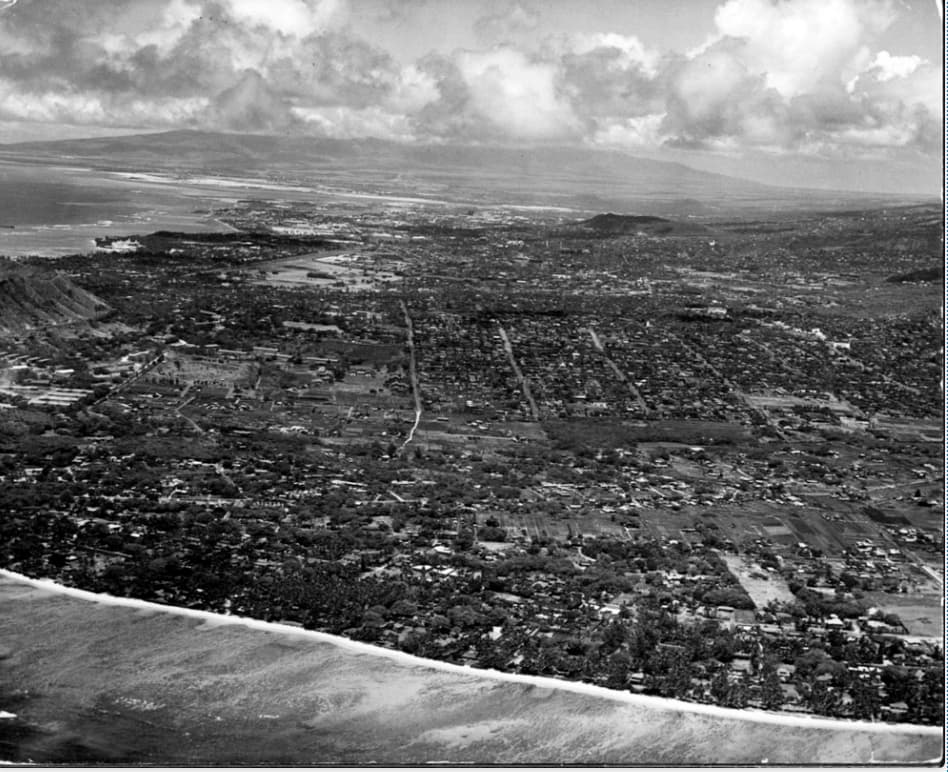
(Kahala, Oahu, 1950)
www.ilind.net says in comment “As you can see, the area along the oceanfront, and Kahala Avenue, is already built up. Lots of homes are crowded in that strip of land”.
But, then, these are the People of the Lie.
Here’s a picture of civilbeat.org’s shill, Denby Fawcett, where the image is blatantly constructed to focus attention on her left eye.

(civilbeat.org’s shill, Denby Fawcett)
shill - noun - an accomplice of a hawker, gambler, or swindler who acts as an enthusiastic customer to entice or encourage others.
The photo emphasizes her left eye because, to bloodline-linked Illuminists like Denby Fawcett, the left eye is the “eye of Will” or the “eye of Horus”.
‘The right eye is the Eye of Ra and the left is the Eye of Horus’.”
From “Freemasonry - Religion And Belief - The 3rd Temple”
Facebook: “Welcome to the Left-Hand-Path-Network, where Satanism is not about worship, but it’s study.”
I have included her picture so that you could get a better idea of what a generational Satanist Freemason of marginal influence looks like.
They are all related to one another through the maternal bloodline. Generational Satanists comprise between twenty and thirty percent of the populace, and are hiding in plain sight in every city, town and village on Earth. It’s how the few have controlled the many all the way back to Babylon, and before.
But they say that the hardest part of solving a problem is recognizing that you have one.
Don Croft used to say “Parasites fear exposure above all else”.
How long do you think that these people have left in power, now?
Please consider doing what you can to help speed the transition.
In 2022, during subsequent ethnographic field work with the Lio community of east central Flores island, Gregory Forth documented accounts of documented sightings of an “ape-man” believed to be H. floresiensis on Flores. The people he interviewed referred to it as “lai ho’a”.
While the details of the descriptions varied, most often they combined a body height of approximately 91 cm (3’3"), with walking and standing mostly bipedally, more body hair than the Lio, they were rarely seen and then in usually low light and lived in the forested mountains. They were also cultureless, not making or using tools, and known to frequent caves. Importantly, unlike the Nage’s “ebu gogo”, the “lai ho’a” were possibly still alive.
Most informants described a standing height of around a meter, with some estimates 60cm or less. Physical attributes of thin to sturdy, strong, hairier than the Lio, with 11 informants describing them as hairy as a monkey. Faces vary from hairy to hairless, some with short head hair and hair colour in the primate range of reddish to black.
Here we have the short-statured, hairy, red-haired Manahune.
Patient readers will recall that the Biblical Esau was smaller than his twin brother, Jacob, and was covered in red hair.
Jeff Miller, Honolulu, HI, December 11, 2025
If you’d like to be added to this free mailing list, or know someone who would be, please send me a note at [email protected].