“All courses of action are risky, so prudence is not in avoiding danger (it’s impossible), but calculating risk and acting decisively. Make mistakes of ambition and not mistakes of sloth. Develop the strength to do bold things, not the strength to suffer.”
― Niccolo Machiavelli
This is 2016, from “The Etheric Origin of Species, and Microwave Radiation as a Driver of their Extinction”.
2016
SUMMARY
In 2016, the increases in the water clarity of the Atlantic Ocean off New Jersey and Iowa’s Storm Lake and the 12% increase in water clarity in California’s Lake Tahoe all occurred simultaneously.
From 2016 to 2017, the respective 1.25% (average), 3.6% (average), 3.8% (average), , 5% (average), 6% (average), 26% (average) decreases in Ozone in Brown County, Wisconsin, strong evidence of cyanobacteria blooms on Lake Kegonsa in Wisconsin, severe thunderstorms and tornadoes in Iowa, , earthquakes of 4.0 or larger in Oregon and Washington compared to the the three decades from 1969 to 1999, lightning deaths in the United States, and earthquakes of 3.0 or larger in Oklahoma all occurred simultaneously.
From 2016 to 2017, the respective 5.3% (average), 6.8% (average), 12.5% (average), 14% increases in the volume of Vietnam’s seafood catch, the volume of bigeye tuna production in the Philippines, butterfly numbers on Hope Farm in the U.K. and egg production at the hatchery on Storm Lake in Iowa all occurred simultaneously.
From 2016 to 2017, the size of the cisco, or lake herring in Lake Champlain in Vermont increased exponentially; the respective .3% (average), 1.2% (average), 4.1% (average) 4.5% (average) increases in the size of the blue catfish in Ohio, the dog snapper in the Gulf of Mexico off Texas, the blueline tilefish in the Atlantic Ocean off Delaware and the blue catfish in Georgia all occurred simultaneously.
In 2016, the largest bluefin tuna in the history of spearfishing in California was caught in the Pacific Ocean; the largest bluefin tuna in the history of fishing in California was caught in the Pacific Ocean, and the junior female world record swordfish was caught in the Pacific Ocean off Australia.
In 2016, after an absence of less than a year, the swordfish reappeared in the Pacific Ocean off Australia, off Tasmania; after an absence of two years, the blue catfish reappeared in West Virginia in the Ohio River; after an absence of six years, the tiger shark reappeared in the Gulf of Mexico off Mississippi; after an absence of almost twenty years, Spix’s macaw reappeared in Brazil for the first time since 2000; after an absence of fifty years, Basilewski’s Cranefly reappeared on St. Helena Island in the South Atlantic for the first time since 1966; after an absence of some indeterminate period of time, Atlantic bluefin tuna once again began spawning in the Slope Sea in the Atlantic Ocean 50 miles off the coast of the Northeastern United States, where they had never been documented previously; the bluefin tuna reappeared in the Pacific Ocean off Calfornia; the bull shark reappeared in the Gulf of Mexico off Mississippi, where it had never been documented previously, and the blue catfish reappeared in Colorado, where it had never been documented previously.
Prior to 2016, there are no verifiable examples of the bull shark in the Gulf of Mexico.
The species had been driven out of existence by the low-wavelength microwave radiation from what we collectively refer to as technology.
From 2016 to this writing in 2026, the blue catfish remains absent from the record in West Virginia in the Ohio River.
From 2016 to 2022, the size of the verified West Virginia state record blue catfish increased by an annual average of 1%.
From 2016 to 2022, the 1% average annual increase in size of the verified West Virginia state record blue catfish was 77.7% less than its 4.5% average annual increase from 2014 to 2016.
From 2016 to 2022, the verifiable West Virginia state record blue catfish increased in size by 6.1%, from 57.75 pounds (Blauvelt, Ohio River) to 61.28 pounds (Carver, Kanawha River).
Given that Mark Blauvelt killed and ate the example that he caught in the Ohio River in 2016, and further given the fact that Cody Carver caught and released his blue catfish on a completely different river, we know that, in 2022, the blue catfish reappeared in the Kanawha River in West Virginia, where the species had never been documented previously, at a weight of 61.28 pounds.
From 2016 to 2020, the 1.25% average annual decrease in Ozone in Brown County, Wisconsin was statistically very similar to the 1% decrease in Ozone in China in 2021.
From 2016 to 2020, 8-hour Ozone design values in Brown County, Wisconsin decreased by 5%, from 65 parts per billion to 62 parts per billion. that’s an average decrease of 1.25% over each of those 4 years.
In 2016, the greatest Secchi measurement at Caspian Lake in Vermont was 10 meters.
In 2016, the News-Press said “Turquoise-blue water appears … in New Jersey”.
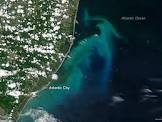
(Caribbean-blue water suddenly appears in New Jersey for the first time in memory, 2016)

(Caribbean-blue water suddenly appears in New Jersey for the first time in memory, 2016)
The uncredited author said it was because of “a phytoplankton bloom and a drought across much of the Northeast has caused the waters of the southern Jersey Shore to look more tropical than at any time in recent memory. The phenomenon has been going on for 10 days, and will continue for as long as wind patterns allow it.”
For those unaware, anytime an author is uncredited, it is proof that said author is an Intelligence operative.
While, per noaa.gov, “Precipitation averaged across the continental United States in 2016 was 31.70 inches, 1.76 inches above (or 6% above - ed) the 20th century average. This was the 24th wettest year on record”.
I have exposed the duplicity of the uncredited Intelligence operative from the State propaganda organ known as the News-Press by using what was known in the old days as “fact checking”.
Further, patient readers will recall that, from 2015 to 2016, water clarity in California’s Lake Tahoe decreased by 6%, and .Researchers from U.C. Davis said it was caused by
“Warmer water and lack of snow”. While those same Researchers attributed a 10.2% increase in water clarity from 2013 to 2014 to “drought”.
From 2016 to 2017, water clarity in Iowa’s storm lake was said to have “increased”.
From 2016 to 2017, the increases in water clarity in the Atlantic Ocean off New Jersey and in Iowa’s storm lake occurred simultaneously.
That’s because the health of the ether is inexorably improving, and water clarity varies directly with the health of the ether.
From 2016 to 2017, the size of the cisco, or lake herring in Lake Champlain in Vermont increased exponentially.
From 2016 to 2017, the verified Ohio state record blue catfish increased in size by .3% (average).
From 2016 to 2017, the size of the verified West Virginia state record blue catfish increased by 1% (average).
From 2016 to 2017, the dog snapper in the Gulf of Mexico increased in size by 1.2% (average).
From 2016 to 2017, Ozone in Brown County, Wisconsin decreased by 1.25% (average).
From 2016 to 2017, strong evidence of cyanobacteria blooms on Lake Kegonsa in Wisconsin decreased by 3.6% (average).
From 2016 to 2017, severe thunderstorms and tornadoes in Iowa decreased by 3.8% (average).
From 2016 to 2017, the Delaware state record blueline tilefish increased in size by 4.1% (average)
From 2016 to 2017, the verified Georgia state record blue catfish increased in size by 4.5% (average).
From 2016 to 2017, the volume of Vietnam’s seafood catch increased by 5.3%.
From 2016 to 2017, lighting deaths in the United States decreased by 6% (average).
From 2016 to 2017, the volume of bigeye tuna production in the Philippines increased by 6.8% (average).
From 2016 to 2017, water clarity in California’s Lake Tahoe decreased by 12%.
Researchers from U.C. Davis said that a 12% decrease in clarity in Lake Tahoe was due to “record snow and rain”.
Patient readers will recall that, from 2015 to 2016, water clarity in California’s Lake Tahoe decreased by 6%, and Researchers from U.C. Davis said it was caused by “Warmer water and lack of snow”. While those same Researchers attributed a 10.2% increase in water clarity in Lake Tahoe from 2013 to 2014 to “drought”.
Essay: Explain how drought increased water clarity in Lake Tahoe by 10.2% in 2013, decreased water clarity there by 6% in 2015 and increased water clarity in New Jersey to an all-time high in 2016, and then explain how record snow and rain decreased water clarity in Lake Tahoe by 12% from 2016 to 2017.
Answer: The folks in charge are not your friends, and are lying to you about baically everything, including the drivers of water clarity in California and New Jersey.
From 2016 to 2017, butterfly numbers on Hope Farm in the U.K. increased by 12.5% (average).
From 2016 to 2017, egg production at the hatchery on Storm Lake, Iowa increased by 14%.
From 2016 to 2017, earthquakes of 3.0 or larger in Oklahoma decreased by 26% (average), or by more than one fourth.
From 2016 to 2017, the respective 5% and 26% decreases in earthquakes of 4.0 or larger in Oregon and Washington compared to the the three decades from 1969 to 1999 and earthquakes of 3.0 or larger in Oklahoma occurred simultaneously.
This documents the fact that seismic activity in the United States is decreasing exponentially regardless of geography.
From 2016 to 2017, the swordfish in the Pacific Ocean off Australia increased in size by 29.4%, or by almost one third, from 589 pounds, 8 ounces (South Tasmania) to 769 pounds.
On May 14, 2016, Mark Blauvelt caught the West Virginia state record blue catfish, in the Ohio River. It weighed 59.74 pounds and was 44.88 inches long.
On June 7, 2016, per the Mississippi Sportsman’s Bobby Cleveland, David Rogers caught the Mississippi state record bull shark, which weighed 203 pounds.
There are no verifiable Mississippi state record bull sharks prior to 2016.
On June 7, 2016, per the Mississippi Sportsman’s Bobby Cleveland, David Rogers caught the Mississippi state record tiger shark, which weighed 390 pounds.
There are no verifiable Mississippi state record tiger sharks prior to 2016.
In 2016, mississippisportsman.com’s Bobby Cleveland said “Giant rodeo sharks now state records”.
Where, under the false guise of familiarity, the tiger shark and the mako shark have been walked back to the general “sharks”, and where “Mississippi state records” has been walked back to the general “state record”, and the largest tiger shark and mako sharks in the history of fishing in Mississippi have been walked back to merely “giant”.
The article goes on to say “David Rogers of Theodore, Ala., didn’t just break the two records, he shattered them. His 203-pound bull shark caught July 1 broke a three-year-old record of 164 pounds, six ounces. His 390-pound tiger shark caught the next day more than doubled the existing record of 173 pounds, 12 ounces set in 2010 That’s over 255 pounds Rogers added to the record book, which is maintained by the Mississippi Department of Marine Resources. Both were caught by conventional methods.”.
Where, under the false guise of familiarity, the general “record” and “records” redact “state record”, which, in turn, redacts “Mississippi state record”.
And where the specific margins between the records was redacted and replaced with the lurid-but-general “shattered”, and the general “more than doubled”.
While the general “three-year-old” redacts the year of the previous Mississippi state record bull shark. So, I had to do the math.
The claimed 2007 Mississippi state record bull shark does not have an angler.
Further, the 2007 Mississippi state record bull shark cannot be verified by contemporary news articles or photographs.
That’s because it is a fabricated state record fish, part of a larger Confidence game to obscure the fact that the bull shark had been driven out of existence in the Gulf of Mexico by the low-wavelength microwave radiation from what we collectively refer to as technology.
I have exposed the duplicity of Bobby Cleveland and his employer, the Mississippi Sportsman by using what was known in the old days as “fact checking”.
The claimed 2010 Mississippi state record tiger shark does not have an angler.
It is a fabricated state record fish, part of a larger Confidence game to obscure the fact that the tiger shark had been driven out of existence in the Gulf of Mexico by the low-wavelength microwave radiation from what we collectively refer to as technology.
In 2016, per a-z-animals.com, “A 213-pound sailfish was caught in 2016 by angler Chase Offield off the coast of Florida”.
(verify)
In 2016, the largest bluefin tuna in the history of spearfishing in California was caught in the Pacific Ocean. It weighed 269 pounds, 11 ounces.
In 2016, the largest bluefin tuna in the history of fishing in California was caught in the Pacific Ocean. It weighed 395.4 pounds.
In 2016, the junior female world record swordfish was caught in the Pacific Ocean off Australia. It weighed 589 pounds, 8 ounces.
In 2016, after an absence of six years, the tiger shark reappeared in the Gulf of Mexico off Mississippi as the health of the ether improved to the point where the species could once again manifest within it.
It weighed 390 pounds, which was 124.5% larger, or more than two times larger than the 173 pounds, 12 ounces at which it had last manifested there in 2010.
David Rogers caught it, killed it, had it certified as the first and only verifiable Mississippi state record, and ate it.
Since this is a quantum increase in size which cannot be explained by Charles Darwin’s theory of natural selection, we can deduce that the tiger shark disappeared in 2010, and reappeared at an exponentially greater size in 2016.
In 2016, after an absence of some indeterminate period of time, Atlantic bluefin tuna once again began spawning in the Slope Sea in the Atlantic Ocean 50 miles off the coast of the Northeastern United States, where they had never been documented previously.
With this following bluefin tuna spawning taking place east of the Bahamas in 2013, which was the first time in history that bluefin tuna spawning had taken place outside of the Gulf of Mexico.
In 2016, after an absence of some indeterminate period of time, the bluefin tuna reappeared in the Pacific Ocean off California at weights of 173.3 pounds, 245 pounds and 269 pounds.
In 2016, after an absence of less than a year, the swordfish reappeared in the Pacific Ocean off Australia, off Tasmania, as the health of the ether improved to the point where the species could once again manifest within it.
In 2016, after an absence of two years, the blue catfish reappeared in West Virginia in the Ohio River, as the health of the ether improved to the point where the species could once again manifest within it.
Mark Blauvelt caught it, killed it, had it certified as the third verifiable Virginia state record blue catfish, and ate it.
The blue catfish remains absent from the record in the Ohio River to this day.
In 2016, after an absence of some indeterminate period of time, the bull shark reappeared in the Gulf of Mexico off Mississippi at a weight of 203 pounds, as the health of the ether improved to the point where the species could once again manifest within it.
David Rogers caught it, killed it, had it certified as the first and only verifiable Mississippi state record, and ate it.
In 2016, after an absence of some indeterminate period of time, the blue catfish reappeared in Colorado, where it had never been documented previously, as the health of the ether improved to the point where the species could once again manifest within it.
In 2016, after an absence of fifty years, Basilewski’s Cranefly reappeared on St. Helena Island in the South Atlantic for the first time since 1966, as the health of the ether improved to the point where the species could once again manifest within it.
In 2016, after an absence of almost twenty years, Spix’s macaw reappeared in Brazil for the first time since 2000, as the health of the ether improved to the point where the species could once again manifest within it.
In 2016, the first spawning in history of bluefin tuna in the Slope Sea 50 miles off the coast of the Northeastern United states, the reappearance of the bluefin tuna in the Pacific Ocean off California, the reappearance of the swordfish in the Pacific Ocean off Australia and the blue catfish in the Ohio River in West Virginia all occurred simultaneously.
END 2016
Jeff Miller, Honolulu, HI, June 5, 2026
If you’d like to be added to this free mailing list, or know someone who would be, please send me a note at [email protected].